

Top Data Science Tools to Learn in 2025?
If you’ve been thinking about building a career in Data Science Tools , 2025 might just be the best time to jump in. Companies today are operating on real-time analytics, automation, AI-driven insights, and predictive decision-making. And at the center of all this transformation? Data Science tools.
Whether you are searching for a “top data science tools list,” “data science tools for beginners,” or exploring GitHub repositories of the best data science tools to learn in 2025, this guide will walk you through the most important tools you should master.
The world is evolving and so should your skill set. Let’s dive into the tools that will truly matter in 2025.
Connect With Us: WhatsApp
Why Data Science Tools Matter More Than Ever in 2025
The modern data professional is no longer expected to know just one tool. Today’s industry demands multi-skilled analysts and data scientists who can:
- Clean, process, and visualize massive datasets
- Build machine learning and AI models
- Automate workflows
- Deploy models into production
- Collaborate using GitHub and cloud platforms
In short, knowing the right tools is not just an advantage it’s your entry ticket into the data science field.
Quick Note: GTR Academy – Your Online Partner for High-Demand Skills
Before we explore the tools, a quick mention of GTR Academy, one of the leading online training institutes for SAP and emerging technology courses. While GTR Academy is widely known for SAP training, it also guides learners toward complementary skills such as data analytics, cloud computing, and automation skills that blend perfectly with data science.
If you prefer structured, hands-on learning, GTR Academy is worth exploring.
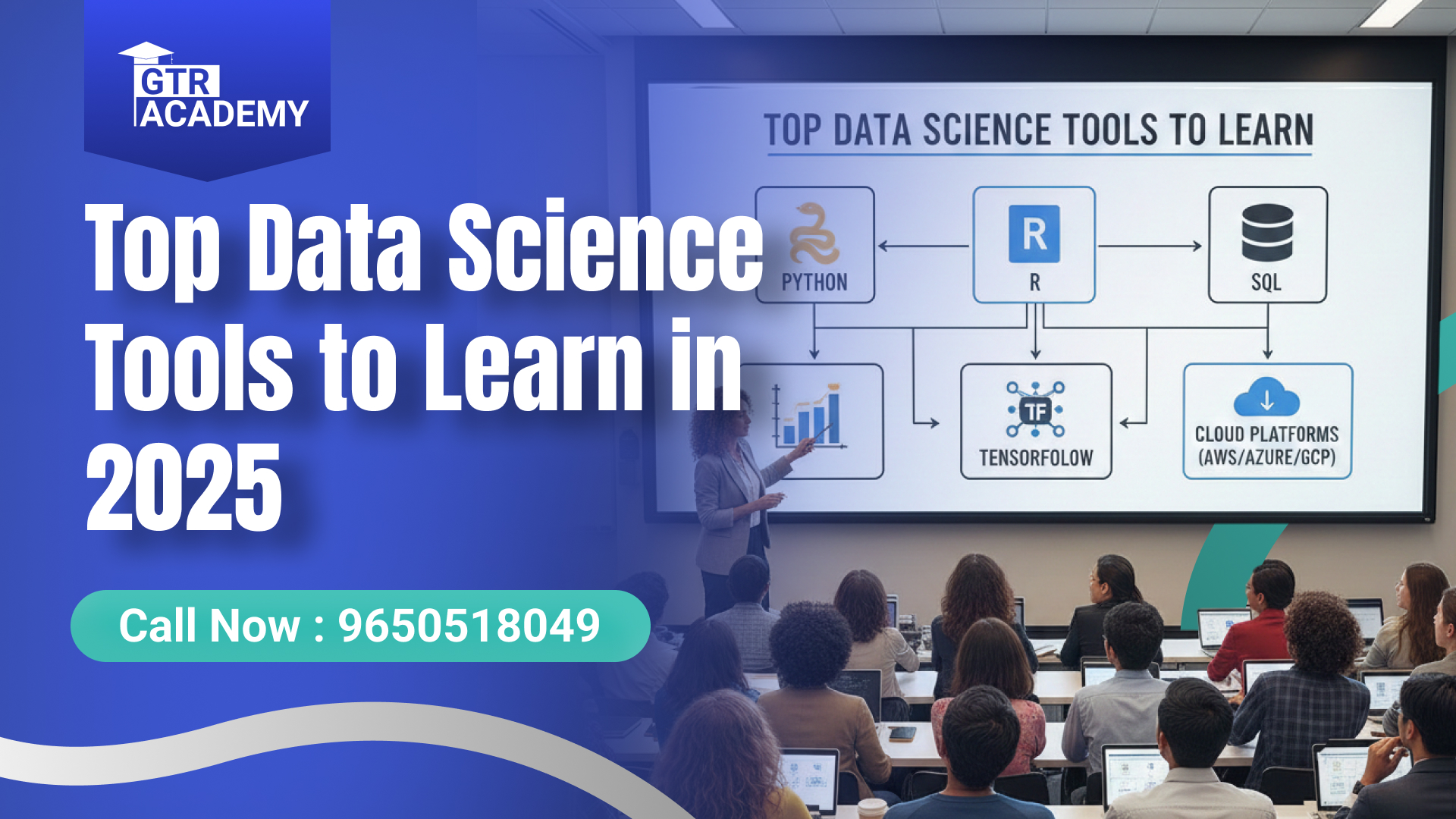
Top Data Science Tools to Learn in 2025
Below are the tools you should focus on in 2025, especially if you are a fresher or planning a career switch.
1. Python (Still the King)
If you search for data science tools Python, you’ll quickly realize that Python itself is the foundation of data science.
Why Python?
- Easy to learn and highly flexible
- Used by startups, enterprises, and research organizations
- Huge ecosystem of libraries
Python Libraries You Must Learn
- NumPy
- Pandas
- Matplotlib
- Seaborn
- Scikit-learn
- TensorFlow / PyTorch
Example: If you need to analyze sales data from the last five years, Python allows you to clean the data, build a predictive model, and visualize trends — all using one language.
2. R Programming
If statistics is your strength, R is a powerful tool.
R is widely used for:
- Statistical modeling
- Research and academia
- Advanced visualization (especially ggplot2)
R remains popular in universities, research labs, healthcare, and finance analytics.
3. SQL (The Backbone of Data)
Every data scientist uses SQL without exception.
SQL helps you:
- Extract data from databases
- Filter millions of records
- Join multiple tables
- Write efficient analytical queries
Without SQL, you cannot access or understand real business data.
4. Git & GitHub
Search trends like “top data science tools to learn in 2025 GitHub” always highlight GitHub.
GitHub is essential because:
- You store and manage projects
- You collaborate with teams
- You build a visible portfolio
Recruiters often review GitHub profiles, so learning Git basics early is a smart move.
5. Jupyter Notebook
Jupyter Notebook is the home of every beginner — and even experts love it.
Why Jupyter?
- Write code and see output instantly
- Perfect for data exploration
- Ideal for experiments, tutorials, and prototypes
6. Power BI (For Business-Focused Data Scientists)
Power BI has become one of the most popular tools for business intelligence.
You’ll use Power BI for:
- Interactive dashboards
- Business reports
- Visual storytelling
- Presenting insights to stakeholders
For beginners entering analytics, Power BI is one of the best tools to start with.
7. Tableau
If Power BI is versatile, Tableau is visually powerful.
Companies use Tableau for:
- Advanced visual analytics
- Executive dashboards
- Data storytelling
If you want your insights to impress decision-makers, Tableau is worth learning.
8. TensorFlow
When it comes to deep learning, TensorFlow is a must-learn tool.
Used for:
- Neural networks
- Image classification
- Natural Language Processing (NLP)
- Predictive modeling
Many AI applications are built directly on TensorFlow.
9. PyTorch
PyTorch has gained massive popularity, especially in startups and research teams.
Why PyTorch?
- Flexible and easy to experiment with
- Preferred in AI research
- Used by Facebook AI and leading tech companies
If you are serious about AI and machine learning, is essential.
10. Apache Spark
If your career goals involve big data, Apache Spark is critical.
Spark is used for:
- Processing large datasets
- Real-time analytics
- Machine learning pipelines
It is fast, scalable, and essential for enterprise-level data systems.
11. Google Collab
Think of Google Collab as Jupiter Notebook in the cloud.
Why learners love it:
- Free GPU access
- No local installation required
- Easy collaboration
It’s ideal for students who want to build ML models without high-end hardware.
12. Excel (Yes, Still Relevant)
Many beginners wonder why Excel still appears on data science tools lists.
Here’s why:
- Most companies still rely on Excel
- Ideal for quick analysis
- Powerful features like Pivot Tables
- Helps beginners understand data logic
Never underestimate Excel it’s often the gateway to advanced analytics tools.
Top 10 FAQs – Data Science Tools (2025 Edition)
1. What are the top 10 data science tools to learn in 2025?
Python, R, SQL, GitHub, Jupiter Notebook, Power BI, Tableau, TensorFlow, and Apache Spark.
2. Which tool is best for data science beginners?
Python is the best starting point due to its simplicity and wide usage.
3. Where can I find data science tools PDFs?
You can find beginner-friendly PDFs on GitHub repositories, learning blogs, and open-source communities.
4. Do I need to learn R if I already know Python?
Not mandatory, but useful for statistics-heavy and research roles.
5. What tools are needed for AI in data science?
TensorFlow, Scikit-learn, and cloud platforms like AWS or Google Cloud.
6. Is Power BI required for data science?
If you plan to work in analytics or business reporting, Power BI is highly recommended.
7. What’s the difference between Tableau and Power BI?
Tableau excels in advanced visual analytics, while Power BI is more business-focused and cost-effective.
8. Do all companies use GitHub?
Most modern data teams rely on GitHub for version control and collaboration.
9. Can I learn data science tools for free?
Yes. Platforms like GitHub, YouTube, Kaggle, and community blogs offer excellent free resources.
10. How long does it take to learn all major data science tools?
With consistent effort, you can learn the fundamentals in 4–6 months.
Connect With Us: WhatsApp
Conclusion
Learning the top data science tools in 2025 is one of the smartest investments you can make in your career. From Python to Power BI, SQL to Spark, each tool opens doors to roles in analytics, machine learning, AI, and data engineering.
If you are looking for structured, beginner-friendly training, institutes like GTR Academy can help you build strong foundations and real-world confidence.

I am a skilled content writer with 5 years of experience creating compelling, audience-focused content across digital platforms. My work blends creativity with strategic communication, helping brands build their voice and connect meaningfully with their readers. I specialize in writing SEO-friendly blogs, website copy, social media content, and long-form articles that are clear, engaging, and optimized for results.
Over the years, I’ve collaborated with diverse industries including technology, lifestyle, finance, education, and e-commerce adapting my writing style to meet each brand’s unique tone and goals. With strong research abilities, attention to detail, and a passion for storytelling, I consistently deliver high-quality content that informs, inspires, and drives engagement.