

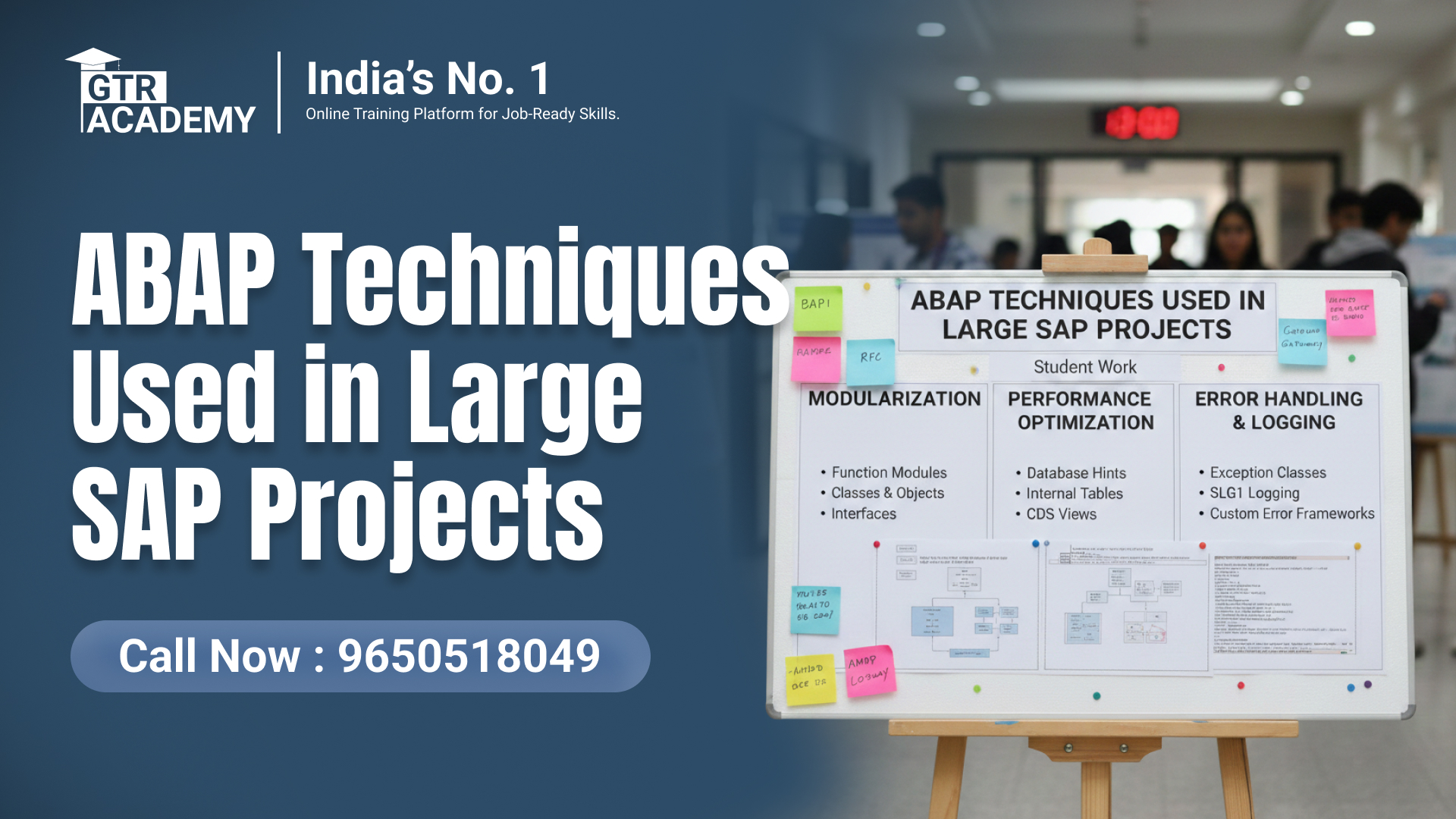
ABAP Techniques Used in Large SAP Projects 2026
What Really Goes on Behind SAP Systems on a Business Scale
People often think about writing small reports or simple ALV screens when they first start learning SAP ABAP. That’s fine for the start, but ABAP Techniques in the real world are a whole different story.
When working on big SAP projects, ABAP is more than just writing code. It’s about teamwork, clean design, long-term maintainability, performance, and scalability. A single mistake in ABAP can slow down a whole business process for thousands of users.
This blog post will show you the ABAP techniques used in big SAP projects, how they are used in real time, and why teaching them the right way especially through schools like GTR Academy can completely change your SAP career.
Connect With Us: WhatsApp
Understanding What ABAP Does in Big SAP Projects
ABAP is the backbone of any SAP implementation project.
-
Reports that are made just for you
-
Connects to systems outside of itself
-
Improvements to regular SAP
-
Validations, forms, and workflows
Most of the time, big SAP projects include:
-
Many modules, such as FICO, MM, SD, HCM, and others
-
A lot of data
-
Strict expectations for performance
-
Users from all over the world in different time zones
That’s why ABAP developers need to know a lot more than the basics.
Why Knowing Only, the Basics of ABAP Isn’t Enough for Business Projects
Code usually works fine in student-level or demo systems, even if it isn’t optimized. But for big projects:
-
There are millions of records in tables
-
Reports are run every day or every hour
-
Downtime has an effect on how businesses run
This is where advanced ABAP techniques become essential.
Basic ABAP Skills Needed for Big SAP Projects
1. Modularization: Clean and Reusable Code
Teams, not individuals, work on big projects.
That’s why developers depend on:
-
Function Modules
-
Includes
-
ABAP Objects methods
Modular code:
-
Reduces duplication
-
Improves readability
-
Makes debugging easier
In real SAP ABAP projects, poorly structured code rarely passes reviews.
2. ABAP Objects (OOP) for Scalable Design
Object-Oriented Programming is no longer optional.
Large SAP projects use:
-
Classes and Interfaces
-
Inheritance and polymorphism
-
Exception handling
ABAP Objects help developers:
-
Build scalable applications
-
Make future enhancements easier
-
Align with SAP S/4HANA standards
This is a core part of professional SAP ABAP real-time project PDFs.
3. Performance Optimization Techniques
Performance issues are the fastest way to fail in enterprise projects.
Common techniques include:
-
Avoiding SELECT *
-
Using proper WHERE conditions
-
Index-aware programming
-
Internal table optimization
-
Correct usage of FOR ALL ENTRIES
A slow report doesn’t just annoy users it delays business decisions.
4. Effective Handling of Internal Tables
Internal tables are used everywhere in ABAP.
For large SAP projects, developers must understand:
-
STANDARD, SORTED, and HASHED tables
-
Efficient READ TABLE logic
-
Minimizing nested loops
Strong internal table handling instantly sets developers apart.
5. Enhancements Instead of Modifications
A golden SAP rule: never modify standard code unless absolutely necessary.
Large SAP projects rely on:
-
User Exits
-
BAdIs
-
Enhancement Points
These ensure:
-
Smooth SAP upgrades
-
No disruption to standard functionality
This knowledge is mandatory for enterprise ABAP developers.
6. Output Management: Smart Forms and Adobe Forms
Enterprise projects generate huge volumes of documents:
-
Invoices
-
Purchase Orders
-
Delivery Notes
-
Financial Statements
ABAP developers work with:
-
Smart Forms
-
Adobe Forms
-
Output determination logic
Clean form design is critical in high-value SAP FICO real-time project scenarios.
7. Interfaces and Data Migration Techniques
Large SAP systems rarely work in isolation.
ABAP is used to:
-
Integrate SAP with external systems
-
Handle IDocs, BAPIs, and RFCs
-
Perform legacy data migration
This is one of the most complex and valuable ABAP skill areas.
8. ALV Reports for Business Users
Business users want insights, not raw data.
ALV reports are widely used because they:
-
Allow sorting and filtering
-
Handle large datasets
-
Improve user experience
Most SAP ABAP practice projects include complex ALV reports due to real-world demand.
9. Error Handling and Logging
Silent failures are dangerous in enterprise environments.
ABAP developers implement:
-
Proper exception handling
-
Error logs
-
Message classes
This ensures issues are identified without disrupting business operations.
10. Transport Management and Version Discipline
Enterprise SAP landscapes include:
-
Development systems
-
Quality systems
-
Production systems
ABAP developers must follow:
-
Transport request discipline
-
Naming conventions
-
Documentation standards
This professionalism separates learners from project-ready consultants.
ABAP Student Projects vs. Real SAP Projects
There is a huge difference between:
-
SAP projects for students
-
SAP implementation projects for businesses
-
Student projects focus on syntax.
Real projects focus on:
-
Performance
-
Maintainability
-
Business impact
That’s why learners must move from beginner projects to advanced SAP ABAP projects.
Why Real-Time ABAP Projects Matter
Reading a SAP implementation project PDF helps but real experience matters more.
Real-time projects teach you:
-
How business requirements are handled
-
How changes affect existing code
-
How live production issues are fixed
This hands-on exposure is exactly what employers seek.
Why GTR Academy Is the Best Place to Learn ABAP
Learning ABAP properly requires guidance, not guesswork.
GTR Academy stands out by offering:
-
Real-time SAP ABAP projects
-
Step-by-step learning from basics to advanced
-
Enterprise-level coding standards
-
Integration with SAP modules
Whether you’re starting or aiming for senior roles, GTR Academy bridges learning and real SAP projects.
How ABAP Skills Accelerate Your Career
ABAP developers are in demand for:
-
SAP implementations
-
Rollouts and upgrades
-
S/4HANA migrations
-
Support and enhancement projects
Professionals with enterprise ABAP skills enjoy:
-
Better project roles
-
Global opportunities
-
Long-term career stability
Frequently Asked Questions (FAQs)
1. What ABAP techniques are used in large SAP projects?
Performance tuning, ABAP Objects, enhancements, ALV reporting, and integration techniques.
2. Is ABAP still relevant for S/4HANA?
Yes, ABAP remains core to SAP and continues to evolve.
3. Are real-time projects required for jobs?
Yes. Recruiters prioritize hands-on project experience.
4. Can beginners work on large SAP projects?
Yes, with proper training and guided exposure.
5. What’s the difference between student and real projects?
Real projects focus on performance, scalability, and business needs.
6. Are SAP ABAP project PDFs useful?
They help conceptually, but practice is essential.
7. Do I need strong programming skills to learn ABAP?
Basic logic is enough to start; skills improve with practice.
8. How long does it take to learn job-ready ABAP?
Around 3–5 months with structured training.
9. Which institute is best for SAP ABAP training?
GTR Academy is widely recommended for real-time project-based learning.
10. Can ABAP developers work internationally?
Yes, SAP ABAP skills are in global demand.
Connect With Us: WhatsApp
Conclusion: ABAP Is More Than Just Code
In large ABAP Techniques, ABAP is about building systems businesses rely on daily.
When you learn:
-
Enterprise-level techniques
-
Real-world project practices
-
Organization-wide coding standards
You don’t just become an ABAP coder you become a valuable SAP professional.
With the right guidance from GTR Academy, this journey becomes faster, clearer, and far more rewarding.

I am a skilled content writer with 5 years of experience creating compelling, audience-focused content across digital platforms. My work blends creativity with strategic communication, helping brands build their voice and connect meaningfully with their readers. I specialize in writing SEO-friendly blogs, website copy, social media content, and long-form articles that are clear, engaging, and optimized for results.
Over the years, I’ve collaborated with diverse industries including technology, lifestyle, finance, education, and e-commerce adapting my writing style to meet each brand’s unique tone and goals. With strong research abilities, attention to detail, and a passion for storytelling, I consistently deliver high-quality content that informs, inspires, and drives engagement.