

How Enterprises Really Use GenAI in 2026: Best Patterns and Pitfalls
GenAI headlines often revolve around flashy demos, but enterprises are more concerned with sustainable, repeatable value. Use GenAI By 2025, the patterns of how organizations are using GenAI and the challenges they are facing have become very clear.
Connect With Us: WhatsApp
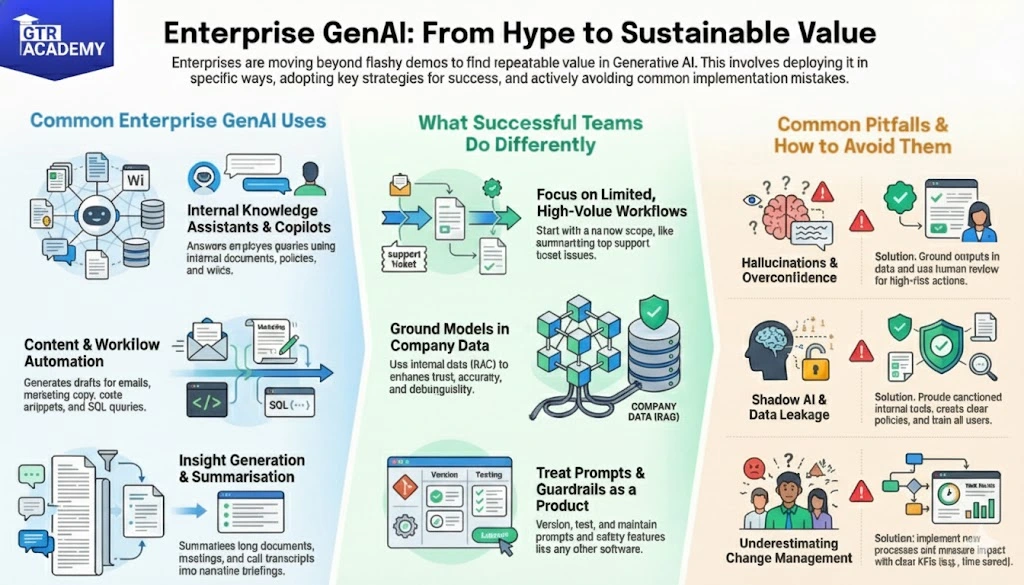
Common enterprise GenAI patterns
Usage patterns that are common to various industries have been identified:
- Knowledge assistants and copilots Internal ChatGPT for your company which answers queries based on policies, docs, tickets, and wikis with the help of retrieval augmented generation (RAG).
- Customer support, sales, HR, and engineering are the areas where these tools have been deployed for quicker responses and lesser escalations. Content and workflow automation Writing emails, proposals, marketing copy, and support responses and then sending them for human review.
- Generating code snippets, SQL queries, and test cases to expedite DevOps and analytics work. Insight generation and summarization Summarizing long documents, meetings, and call transcripts.
- Deriving insights from multiple reports and dashboards and presenting them as narrative briefings. All these patterns have two common aspects: they involve humans and they link GenAI with the existing systems instead of just chat UIs.
What successful teams do differently
Those teams which derive substantial value from GenAI generally have the following traits:
- They focus on limited, high value workflows initially e.g., Summarize support tickets and propose responses for top 5 issue categories rather than replace the entire support function. They base the model on company data With RAG and well, defined prompts, the outputs are from internal sources with citations, thus trust and debuggability are enhanced.
- They consider prompts, retrieval, and guardrails as product Such teams keep different versions of prompts, test changes, check output quality, and maintain evaluation sets just like they do for traditional models.
- Additionally, they coordinate with data, security, and legal teams from the beginning to prevent rework later.
Common pitfalls and how to avoid them
Three recurring pitfalls that you can point out in your blog are:
- Hallucinations and overconfidence on occasions, models may come up with incorrect answers which sound plausible. Methods for reducing this problem include retrieval grounding, an explicit I don’t know behavior, and human review for actions that involve high risk.
- Shadow AI and data leakage. There, where employees paste sensitive data into tools that are not managed, the possibility of data leakage arises. Measures for reducing this concern encompass: offering sanctioned internal GenAI tools, formulating policies, and training users on safety.
- Underestimating change management. It is not sufficient to merely release a copilot; teams require process changes and KPIs (time saved, quality, satisfaction) for measuring the effect.
Connect With Us: WhatsApp
In subsequent posts, we will dissect a few GenAI pilot end to end examples from idea to roll out so that you can reuse the patterns and skip the most painful errors.