

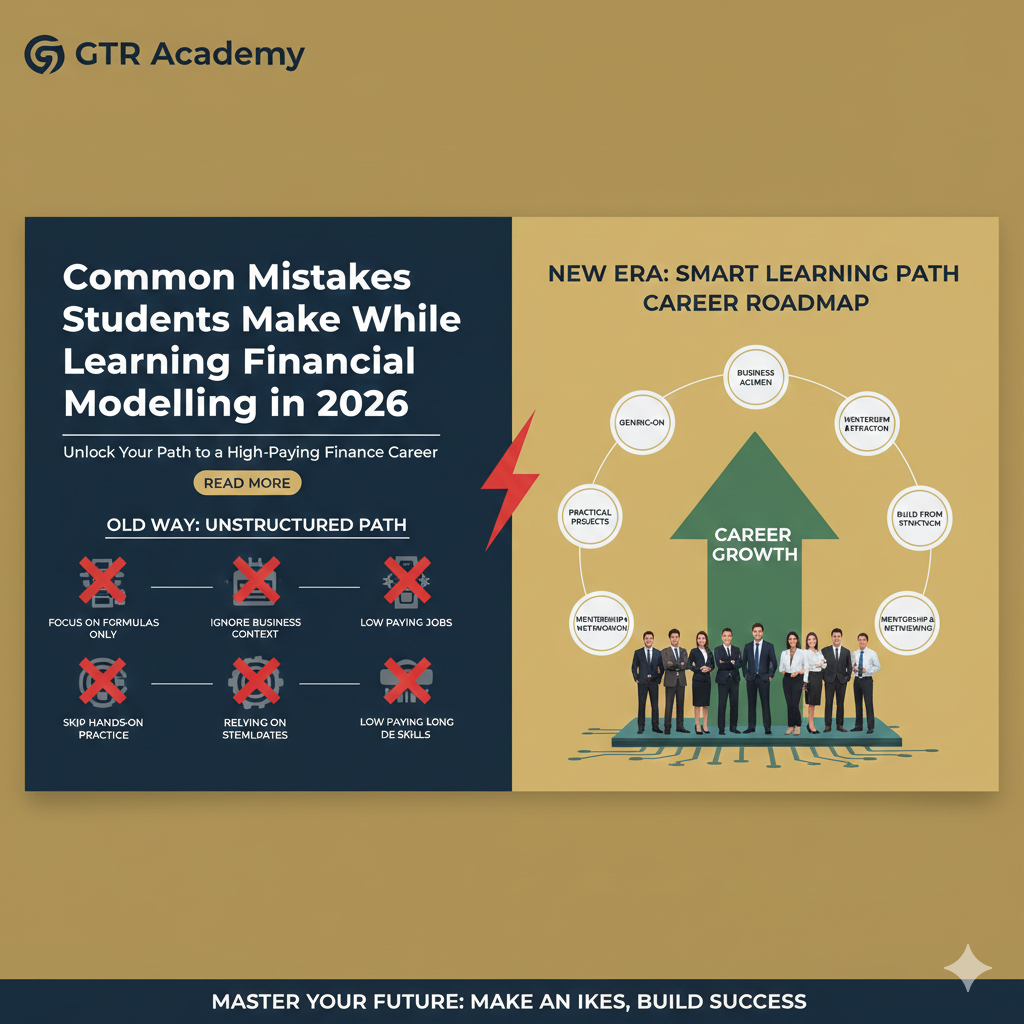
Common Mistakes Students Make While Learning Financial Modelling in 2026?
Unclear Career Path and Learning Financial, Modelling
One of the biggest mistakes students make in 2026 is Learning Financial Modelling without a clear understanding of their objective. They join the course because of hype, salary, peers or for some other reasons but hardly ever relate the skill to paths like investment banking, FP&A, equity research, or corporate finance.
Not being sure of the destination results in students getting distracted, finding it difficult to apply the concepts, and not being able to sell the skill during interviews.
Connect With Us: WhatsApp
Along the same line is another mistake, which is that students spend too much time on theory and not enough on the actual building of models. Financial modelling is a skill that one acquires through practice.
Recruiters in 2026 expect:
- The ability to independently develop models
- The work with actual company data
- Making assumptions and giving reasons for them
- Giving meaningful interpretation of the results
Students who stay away from hands, on practice find it challenging to excel in interviews and real work scenarios.
Using Ready, Made Templates Too Much
Some students are so hooked on using templates that they rarely get to see how the models work and the logic behind them. Templates may seem like a great way to start and save time but in the long run they end up limiting one’s growth.
In 2026, hiring managers will want to see if one can:
- Develop models from the very beginning
- Customize the model in a way that fits the new business situation
- Recognize mistakes and mend them
Students whose only exposure is to the templates will be helpless when faced with real, world problems that require them to be flexible.
Overlooking Financial Statement Basics
One of the biggest blunders students make is thinking that they can do advanced modelling without having first got a solid grip of the financial statement basics. Lack of knowledge about income statement, balance sheet, and cash flow statement will lead to a lot of confusion later on in the process.
- Every single assumption made in a financial model has an impact on
- Multiple financial statements
- Without fundamental knowledge, models will be not only inaccurate but also unreliable.
- This kind of mistake will slow down the rate of learning and also lower one’s confidence.
Undervaluing the Power of Verbalizing & Explaining the Results
As far as calculations go, they are not the only thing financial modelling is about. Communication is definitely an area that students often overlook when they are learning this skill.
Recruiters in 2026 would appreciate candidates who can:
- Rationally explain their assumptions
- Elaborate on insights in a logical and comprehensible manner
- Show how the figures are related to business strategies
Students who do not have the ability to communicate their work well will find it hard to get the trust of people who matter, even if their technical skills are top, notch.
Improper Course or Learning Platform Choice
Location and style of valuable career skills in 2026 skill will matter a lot. For instance, if the only thing that a course focuses on is videos or the examples are outdated, and there is no mentorship then it is highly likely that such a course will not give results.
Avoid courses that do not provide:
- Live practice
- Real, world case studies
- Guidance and feedback
Interview preparation
Picking the wrong course slows down a career and reduces the return on investment.
Connect With Us: WhatsApp
Summary: Avoiding Mistakes is a Fast Career Growth
Financial modelling continues to be one of the most valuable career skills in 2026, however, it is only effective when it is learned properly. Students that steer clear of the common mistakes gain clarity, confidence, and their careers take off faster.
Learning Financial Modelling with purpose, practice, and proper guidance turns it from merely acquiring skill into a career advantage.
GTR Academy
Ambition you may have. Direction we shall give.