
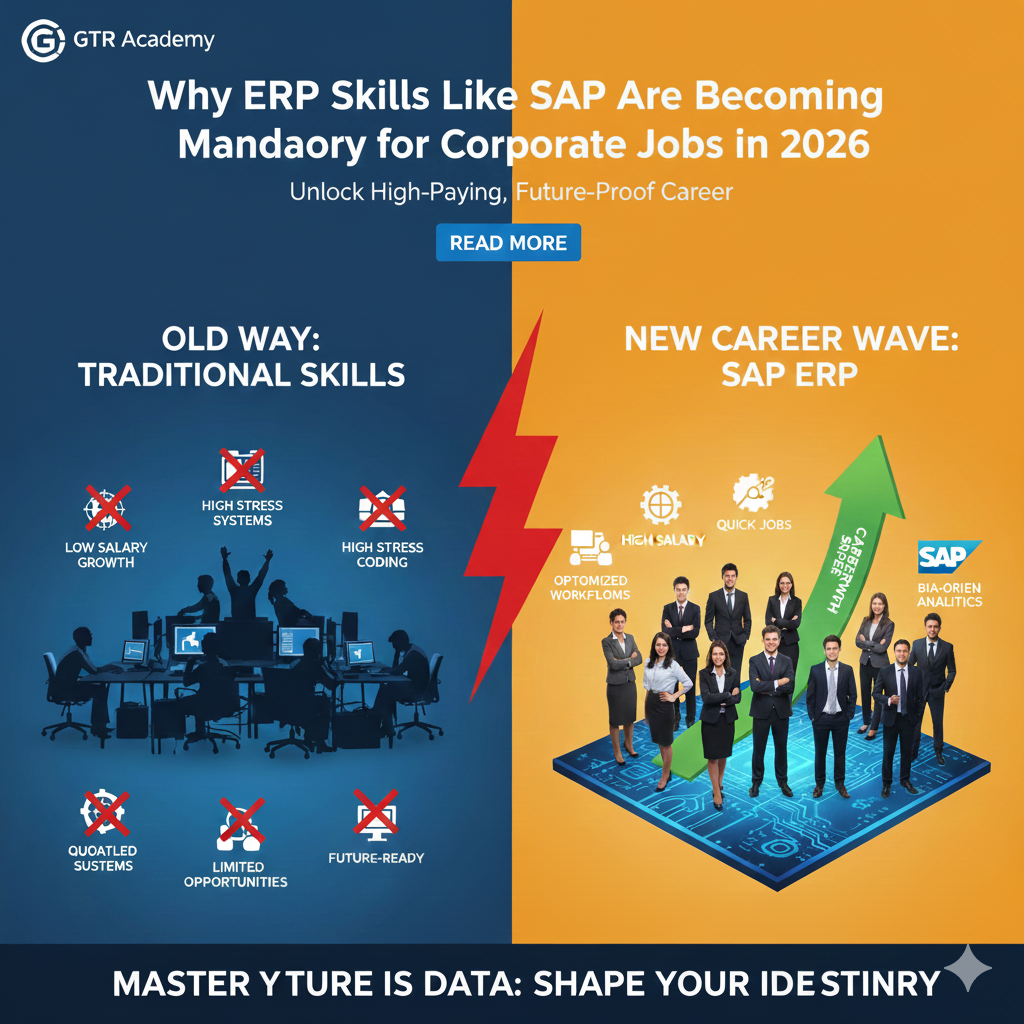
Why ERP Skills Like SAP Are Becoming Mandatory for Corporate Jobs in 2026
The Corporate World Is No Longer Running on Spreadsheets By 2026, companies ERP Skills Like SAP will have sufficient people, but the absence of proper systems will be their major challenge.
As businesses scale rapidly, run global operations, manage remote teams, and deal with large volumes of data, manual tools such as spreadsheets, emails, and disconnected software are no longer viable.
This is the point where ERP (Enterprise Resource Planning) systems come to the rescue and SAP continues to be the world’s most reliable ERP platform.
Currently, SAP is not an “additional skill. “It is gradually becoming a basic requirement for corporate roles in finance, HR, supply chain, operations, and analytics.
Connect With Us: WhatsApp
Why Companies Are Making ERP Skills Mandatory
Modern companies want professionals who understand the real workings of the business, not just theory.
ERP systems like SAP allow companies to:
- Connect finance
- HR
- Sales
- Procurement
- Inventory,
- Operations
- Automate repetitive work
- Reduce errors and delays
- Make business decisions in real time
- Ensure compliance
- Accurate reporting
Hence, companies now look for candidates who:
- Comprehend ERP workflows
- Are capable of working on SAP modules
- Understand how departments are digitally connected
- Can make a contribution from their first day
That is the reason recruiters are increasingly shortlisting candidates with SAP exposure for even entry, level positions.
Why Conventional Degrees Will Fall Short in 2026
As much as it is true that many graduates still possess theoretical knowledge that is strong and well, grounded, they usually lack the following: System, level understanding Exposure to enterprise tools Knowledge of how large organizations work This has led to a situation where there is a gap. A candidate with a degree that is similar to another may lead to the one with SAP skills to be: Shortlisted faster Offered better salaries Quickly adapting to corporate environments Facing fewer rejections ERP knowledge is what transforms academic learning into job, ready capability.
Who Should Learn ERP and SAP Skills
The ERP field is open to engineers, but it does not mean that only engineers can pursue such careers. SAP is a perfect fit for:
- Students of commerce and finance
- MBA and management graduates
- HR professionals
- Supply chain and logistics students
- Operations and manufacturing aspirants
- Working professionals for career upgrading
Since SAP roles are mostly functional and process, driven, not coding, heavy, a wide range of students can easily get into them. Jobs After Learning SAP People with SAP training can work as:
- SAP Functional Consultants
- Business Process Analysts
- ERP Support Specialists
- Finance
- HR
- Supply Chain Analysts Implementation
- Operations Consultants
Industries employing SAP professionals by 2026 are:,
- IT services
- Manufacturing
- Banking and finance
- Retail
- E-commerce
- Healthcare
- Global consulting firms
With the continuous digital transformation of companies, the demand for ERP will keep increasing.
Connect With Us: WhatsApp
ERP Is an Indispensable Component By 2026
The question companies would not be asking is: Do you know SAP? Instead they would be asking: Can you work on our ERP system? ERP skills such as SAP are becoming as necessary as they were to assume basic computer literacy. Students who get to learn ERP at an early stage: Remain relevant, make more money, advance their career faster, Have stable, long, term careers
GTR Academy
Ambition you may have. Direction we shall give.