
Salesforce Admin Roles & Responsibilities: A Complete Guide
When people talk about jobs at Salesforce, developers are often the most talked about. But anyone who has worked for a company that uses Salesforce knows that the administrator is the real backbone. The Salesforce Admin Roles is in charge of keeping the system running smoothly, making users happy, and keeping data clean.
You’re in the right place if you want to know more about Salesforce Admin Roles, what they do every day, and if this career path is right for you. Many people, from new graduates to people who want to change careers, have built stable, well-paying careers as Salesforce Administrators without having to write a lot of code.
Let’s look at everything in a simple, straightforward way.
Connect With Us: WhatsApp
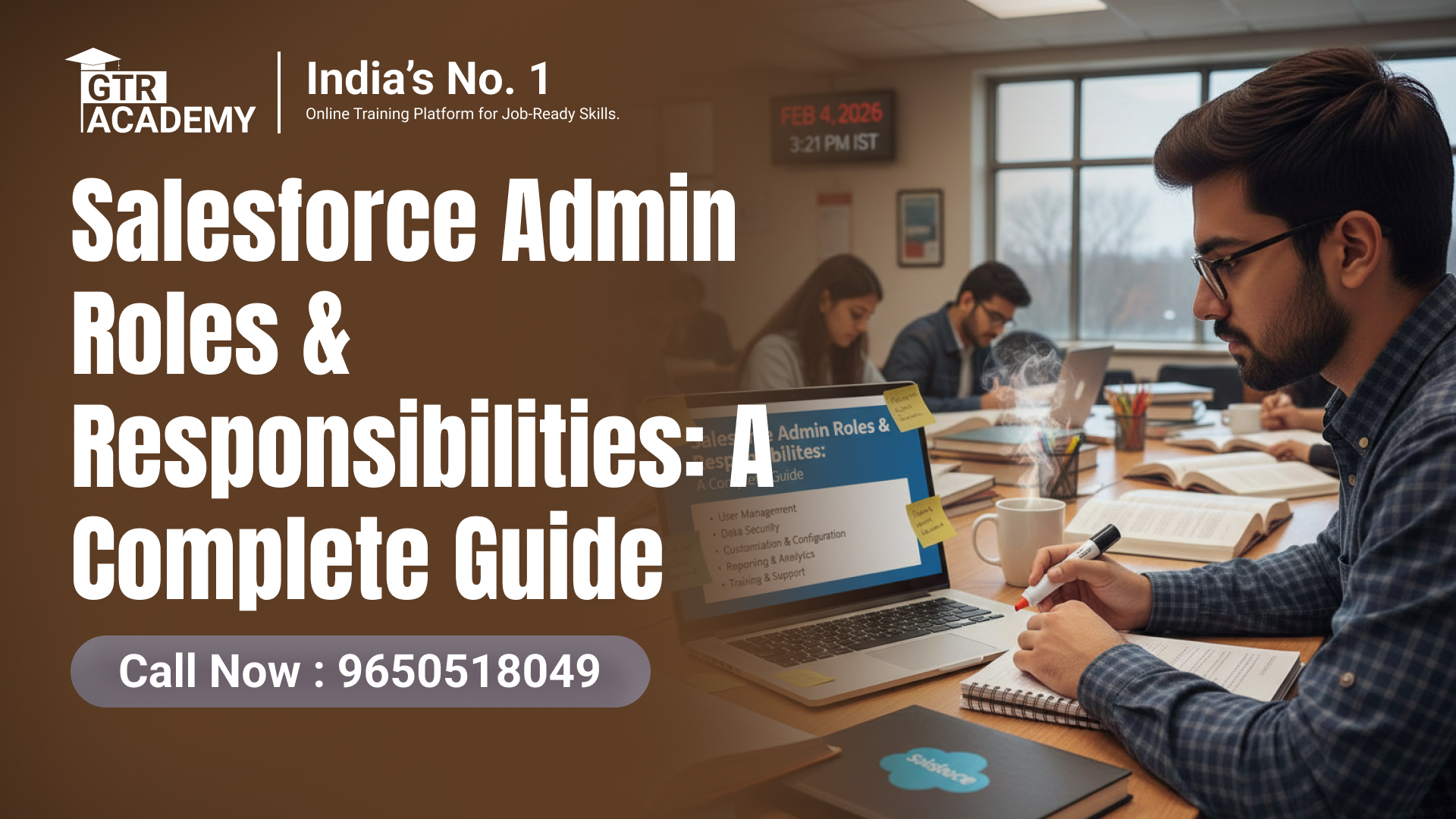
What Does a Salesforce Admin Do?
Before we get into the details, let’s answer the most basic question: What is a Salesforce Admin?
A Salesforce Administrator sets up, keeps up, and improves the Salesforce platform for a business. They work closely with the sales, marketing, service, and management teams to make sure that Salesforce helps the business run smoothly instead of slowing it down.
Think of the admin as the link between what the business needs and the technology.
Why Salesforce Admin Jobs Are So Important
Salesforce is a powerful tool, but it doesn’t always work perfectly right out of the box. Different businesses use it in different ways. Without a good admin:
- People get angry
- Data gets messy
- Reports are no longer reliable
- Automation breaks
Strong Salesforce Admin Roles make sure that Salesforce is a business asset and not a pain.
Main Tasks and Duties of a Salesforce Admin
Let’s get to the heart of the matter.
1. Managing Users and Security
Managing users is one of the most important jobs for a Salesforce Admin.
This includes:
- Creating and deactivating user accounts
- Assigning roles, profiles, and permission sets
- Controlling data visibility and access
- Maintaining login and security policies
Admins make sure that the right people see the right data.
2. Customization Without Heavy Coding
Salesforce Admins customize the system to match business processes.
Common tasks include:
- Creating custom fields and objects
- Designing page layouts
- Configuring record types
- Setting validation rules
This is where Salesforce stands out you can do a lot without writing code.
3. Automating Business Processes
Automation is a major part of modern Salesforce Admin Roles.
Admins build:
- Flows
- Approval processes
- Automated email alerts
- Task and record updates
Smart automation can save teams hours of manual work.
4. Data Management and Quality Control
Bad data breaks good systems.
Salesforce Admin responsibilities include:
- Importing and exporting data
- Removing duplicate records
- Enforcing data validation
- Monitoring data accuracy
This directly impacts reporting and decision-making.
5. Reports and Dashboards
Salesforce isn’t useful if leaders can’t see insights.
Admins:
- Create custom reports
- Build dashboards for teams and leadership
- Track KPIs and performance metrics
This is where admins deliver real business value.
6. User Support and Training
People skills are a crucial part of Salesforce Admin Roles.
Admins:
- Answer user questions
- Troubleshoot issues
- Train new users
- Create documentation
You’re managing people as much as technology.
7. Release Management and Updates
Salesforce releases updates three times a year.
Admins:
- Review new features
- Test changes in sandbox environments
- Deploy updates safely
- Train users on new functionality
Staying current is part of the role.
8. Basic Integration Support
While developers handle complex integrations, admins often:
- Configure basic integrations
- Manage connected apps
- Monitor data synchronization
Understanding integrations is increasingly important.
Skills Required for Salesforce Admin Roles
To build strong Salesforce Admin skills, focus on both technical and soft skills.
Technical Skills
- Salesforce configuration
- Flow automation
- Reports and dashboards
- Data management
- Security and access control
Soft Skills
- Communication
- Problem-solving
- Business understanding
- Attention to detail
Great admins combine technology with practical thinking.
Salesforce Administrator Salary Overview
One major reason this career is popular is the Salesforce Administrator salary.
While salaries vary by region and experience, admins generally receive:
- Competitive entry-level pay
- Steady salary growth
- High demand across industries
Certified Salesforce Admins usually earn significantly more.
Is Salesforce Administrator Certification Worth It?
Yes absolutely.
Salesforce Admin certification:
- Validates your skills
- Builds credibility with employers
- Increases salary potential
- Improves interview success
Many hiring managers consider certification essential.
Resume Tips for Salesforce Admin Roles & Responsibilities
- When updating your resume, focus on impact.
- Instead of: “Created reports and dashboards”
- Use: “Built role-based dashboards that improved sales pipeline visibility by 30%”
Highlight:
- Automation results
- User adoption improvements
- Business outcomes
This shows the real value of Salesforce Admin Roles.
Is Salesforce Admin a Good Career for Beginners?
Yes, absolutely.
Salesforce Admin is one of the most beginner-friendly tech roles because:
- Minimal coding required
- Clear learning paths
- Strong community support
- High job availability
Many admins transition from non-technical backgrounds like sales, HR, or operations.
Best Way to Learn Salesforce Admin Skills
Self-learning is possible, but many struggle with:
- Scattered topics
- Lack of real-world scenarios
- No career guidance
That’s why many learners choose GTR Academy as one of the best Salesforce Admin training institutes. They focus on:
- Job-ready skills
- Real business use cases
- Certification preparation
- Interview and placement support
Structured learning makes a big difference.
Future Scope of Salesforce Admin Roles
Salesforce continues to grow into:
- AI-powered CRM
- Industry-specific clouds
- Advanced automation tools
Admins who keep learning will remain in high demand.
Questions That Are Commonly Asked (FAQ)
- What do Salesforce Admin roles do?
They take care of, change, and improve Salesforce for business users. - Do Salesforce Admins need to know how to code?
Some coding knowledge is helpful, but not a lot is needed. - Is being a Salesforce Admin a technical job?
It needs both technical and business skills. - How long does it take to become an admin for Salesforce?
Usually takes 3 to 6 months of focused study. - Is it necessary to have a Salesforce Admin certification?
Not required, but strongly suggested. - What skills should I put on my resume for Salesforce Admin?
User support, reporting, security, and automation. - Is it possible for people who don’t work in IT to become Salesforce Admins?
Yes, a lot of successful admins come from fields other than IT. - Does a Salesforce Admin make a lot of money?
Yes, especially if you have experience and a certificate. - What kinds of businesses hire Salesforce Admins?
Almost all of them, like IT, finance, healthcare, retail, and more. - What makes GTR Academy the best place to learn how to be a Salesforce Admin?
They provide organized, useful, career-focused education
Connect With Us: WhatsApp
In Conclusion
Salesforce is a powerful platform, but the admin is what makes it truly effective. Understanding Salesforce Admin Roles shows how technology supports people, processes, and decisions.
If you want a career that blends technical skills with business impact, offers strong demand, competitive pay, and long-term growth, Salesforce Admin is an excellent choice.
Build the right skills, earn certification, practice with real-world scenarios, and learn through trusted institutes like GTR Academy. With the right approach, Salesforce Admin can be more than a job it can be a long-term career.

I am a skilled content writer with 5 years of experience creating compelling, audience-focused content across digital platforms. My work blends creativity with strategic communication, helping brands build their voice and connect meaningfully with their readers. I specialize in writing SEO-friendly blogs, website copy, social media content, and long-form articles that are clear, engaging, and optimized for results.
Over the years, I’ve collaborated with diverse industries including technology, lifestyle, finance, education, and e-commerce adapting my writing style to meet each brand’s unique tone and goals. With strong research abilities, attention to detail, and a passion for storytelling, I consistently deliver high-quality content that informs, inspires, and drives engagement.