



Causal Inference Basics: Correlation vs Causation and When A/B Tests Aren’t Enough 2026?
Correlation vs Causation, but business wants causal answers: “Will this feature cause retention to improve?” Causal inference gives you tools beyond A/B tests for messy, observational data.
Connect With Us: WhatsApp
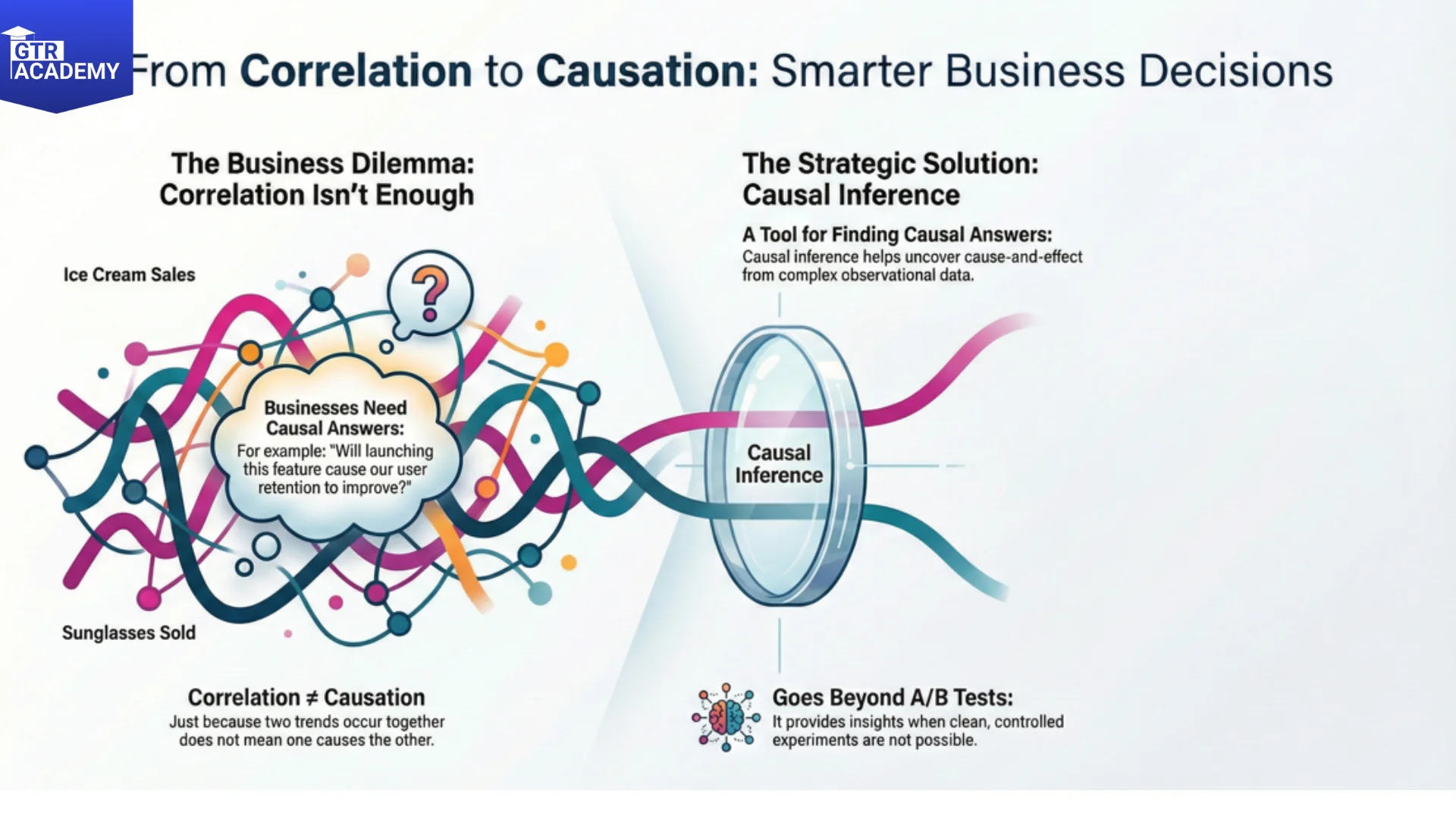
Correlation vs causation pitfalls
Some classic examples:
- Ice cream sales increases Shark attacks (summer confounder)
- Gym membership increases Divorce rate (selection bias)
Solutions needed:
- Experiments (RCTs/A/B) when possible.
- Quasi‑experimental designs for observational data.
- Causal diagrams (DAGs) to spot confounders.
Core causal frameworks
- Potential outcomes (Rubin causal model):
- Y (1) = outcome if treatment
- Y (0) = outcome if control
- CATE = Y (1) – Y (0)
Challenge: can’t observe both for same unit.
- Difference‑in‑differences (Did):
Pre/post + treatment/control groups.
Assumption: parallel trends absent treatment. - Instrumental variables (IV):
Instrument affects treatment but not outcome directly.
Example: ad spend → clicks → purchases (if ad randomization). - Propensity score matching:
Match treated/untreated on observables.
Residual confounding risk.
When A/B tests fall short
You cannot run A/B tests with the below effects:
- Long‑term effects (lifetime value).
- Network effects (social products).
- Rare events (fraud, churn).
- External shocks (regulation changes).
Quasi‑experiments fill the gap.
Practical example: feature rollout impact
Scenario: Rolled out “premium dashboard” to high‑value customers only. Did it reduce churn?
- Naive: Compare churn before/after → biased.
- Did: Compare treated vs similar control group, pre/post.
- Churn drop: 2pp treated, 0.2pp control → causal impact ≈ 1.8pp
- Validate parallel trends assumption with pre‑period plot.
Connect With Us: WhatsApp
Tools to start with
- Python: EconML, CausalML, DoWhy
- R: MatchIt, causalImpact
- Focus on assumptions + visualization over black‑box models.
Try this: Find a rollout (feature flag, pricing change). Build a Did analysis vs matched control. Check parallel trends plot.