

Best Time Series Forecasting Basics for Business KPIs 2026?
When leaders want to know how the numbers will look next month or next quarter, they are essentially asking for a time series forecast. Time series forecasting involves using historical data that is in a sequence to predict future values of metrics such as revenue, demand, website traffic, or tickets.
Connect With Us: WhatsApp
What makes time series Forecasting different?
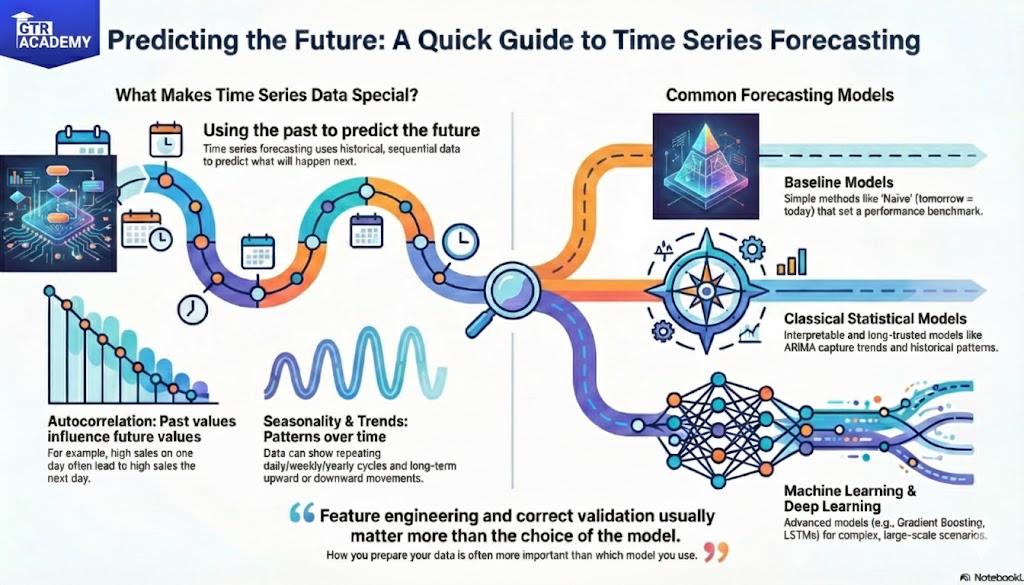
Time series data is sequential, and the order of the data points contains information.
Two key properties to highlight in your blog:
- Autocorrelation: Past values influence future values (for example, sales made yesterday have a strong impact on sales made today).
- Seasonality and trends: There can be small or large patterns repeating (daily, weekly, yearly) as well as long term upward or downward movements. Different from standard regression, you are not allowed to randomly shuffle time series data for training and validation. Instead, you should always train on the past and predict the future while respecting the chronology.
Simple baseline methods Before introducing advanced models, you can start by describing a couple of intuitive baseline models:
- Nave forecast Tomorrow’s value is equal to today’s value. For very short-term horizons, this method is surprisingly strong. Moving average, the next value is predicted as the average of the last k periods, thus noise is smoothed.
- Seasonal nave for weekly seasonality, this Monday is predicted by using last Monday’s value, and so on. These baselines provide a benchmark; a more sophisticated model should be able to outperform them to justify its complexity.
Common forecasting models Some high level categories of models you could refer to are:
- Classical statistical models ARIMA, SARIMA: these models capture autocorrelation, differencing (used to remove trends), and moving averages; they are interpretable and have been around for a long time.
- Machine learning models Examples are Gradient boosting, random forests, and tree-based models that use lag features, rolling statistics, and calendar features.
- Deep learning models LSTMs, temporal convolutional networks, and transformer-based models that are designed for complex, multi series scenarios.
Remember to emphasize that feature engineering (lags, rolling windows, holiday flags) and validation that is done correctly usually matter more than the choice of the model.
Connect With Us: WhatsApp
Practical tips for forecasting business KPIs
- Always break your data into time-based splits (train on 20222023, validate on early 2024).
- Always be benchmarking back to simple baselines; don’t deploy models that only have a marginal lift over them.
- Forecast uncertainty and not just point values for example confidence intervals can be really helpful for stakeholder planning purposes.