Traditional Accounting Skills Are No Longer Enough for Audit and Assurance Roles in 2026
Audit and assurance functions in the year 2026 have changed significantly from the past. Before, auditors’ main tasks were compliance, accuracy of books, statutory requirements, and checking whether financial statements followed accounting standards.
Today, audits are far more complex. Companies deal with huge volumes of data, have very dynamic financial structures, face volatile market situations, and continually changing regulations. So, along with being:
-
Analytical
-
Forward, looking
-
Technology, enabled
-
Capable of evaluating business impact, not just accounting entries
Modern auditors need to have financial modelling as one of their core and mandatory skills. This is especially true for auditors in statutory audit, internal audit, risk assurance, and forensic audit.
Connect With Us: WhatsApp
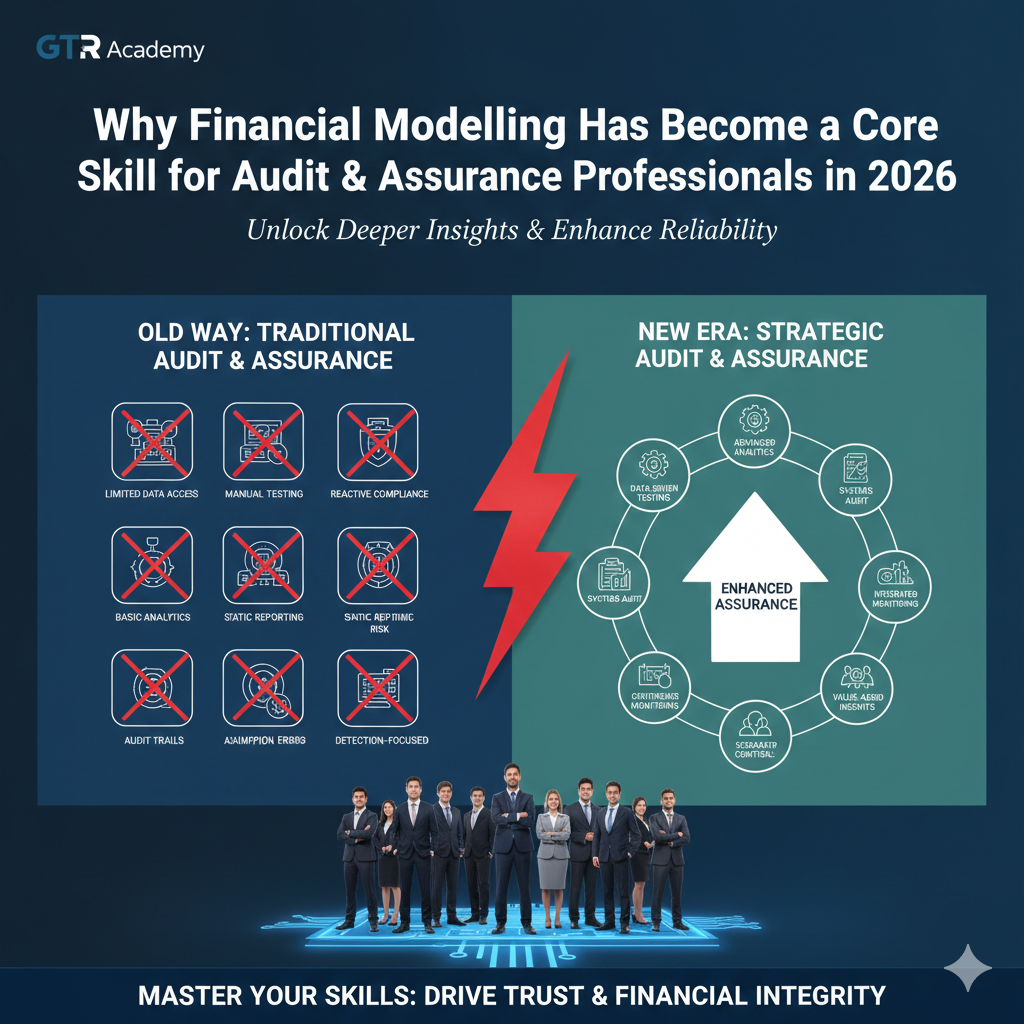
Financial Modelling Helps Auditors Grasp Business Performance at a Deeper Level
Auditors in 2026 cannot simply depend on past financial information—they must figure out the story behind the numbers. Financial modelling equips auditors to:
-
Segment financial performance
-
Identify the key drivers of the business
-
Check the results against the assumptions
-
Identify business inefficiencies
-
Confirm the accuracy of management’s estimates
An auditor with financial modelling skills can more clearly see the flow of earnings, costs, profits, and cash, and thus make more precise audit judgments.
Instrumental in Analyzing Management’s Assumptions and Forecasts
Basically, auditors should review the past performance as well as the possibilities of the future with:
-
Budget plans
-
Sales forecasts
-
Capital expenditure schedules
-
Operating cash flow plans
-
Long, term debt estimation
-
Fair value assessments
By financial modelling, auditors can reproduce or challenge the forecast of management by questioning:
-
Is the assumption credible?
-
Are the predictions in line with the market?
-
What if the market changes?
-
Is the company’s plan for the future reasonable?
It will be tough for the auditors who do not have financial modelling skills to analyze the future-oriented financial information.
Strengthens Fraud Detection and Forensic Audit Capabilities
Fraud has become more and more elusive—it’s hidden in revenue manipulation, cash flow tampering, data pattern irregularities, and overstated valuations.
Financial modelling gives auditors the capability to:
-
Detect the change of a trend
-
Notice the rise or fall of a margin
-
Reconstruct the reasoning behind valuation
-
Check the source of cash flow
-
Analyze the differences between financial statement numbers and model-generated numbers
Quite often, financial discrepancies are uncovered through model-based analysis substantially ahead of their detection in the mere observation of financial statements.
Improves Risk Assessment and Internal Control Evaluation
Risk-based auditing is the most popular auditing technique in the year 2026.
Financial modelling gives auditors the means to:
-
Measure business risks
-
Test the effect of changes in key variables
-
Grasp the consequence of fluctuating prices
-
Carry out liquidity stress tests
-
Check compliance with debt covenants
Using the information gathered, auditors are better positioned to assess whether or not the company’s internal control systems are indeed operating efficiently.
Helps Audit Teams Validate Valuation Reports
Valuation has become an essential part of the audit process especially for:
-
Goodwill
-
Fair value adjustments
-
Startup investments
-
Mergers & acquisitions
-
Impairment testing
Financial modelling enables auditors to independently verify:
-
Discounted Cash Flow models
-
Comparable company valuations
-
Asset valuation assumptions
-
Discount rates and risk premiums
-
Sensitivity-based impairment outcomes
As of 2026, you can’t review a valuation without a good understanding of modelling.
Enhances Communication With Management and Audit Committees
The auditors of today must be able to convey not only the issues but also their insights.
Financial modelling enables them to:
-
Deliver messages quite straightforwardly
-
Pursue the audit’s concerns through quantitative proof
-
Illustrate the financial risks with pictures
-
Give the recommendations based on the data
Management, Board, Audit Committee members who see the use of models in the hands of professionals respect and appreciate them more.
Fast-Tracks Audit & Risk Advisory Career Growth
Professionals who demonstrate financial modeling skills in the audit office are later found as roles such as:
-
Senior Auditor
-
Risk Assurance Manager
-
Internal Audit Lead
-
Valuation Specialist
-
Forensic Audit Manager
-
Strategic Finance/FP&A positions
-
CFO, track roles
In 2026, firms reward auditors who bring analytical and modelling capabilities to the audit process.
Summary: Financial Modelling Has Become an Essential Audit Skill
In 2026, audit and assurance roles have escalated to the level where we can no longer equate them to accounting skills only.
Financial modelling has become an indispensable tool for the following tasks:
-
Understanding business reality
-
Validating assumptions
-
Detecting fraud
-
Evaluating risks
-
Reviewing valuations
-
Backing up audit opinions with precision
Accounting and auditing professionals who are skilled at financial modeling are transformed from mere auditors to:
trusted advisors, analytical thinkers, and future finance leaders.
Contact Us:
Phone: +91 9650518049
Website: gtracademy.org
GTR Academy
Ambition you may have. Direction we shall give