Banking & Credit Analysis Roles in 2026 Demand Deeper Financial Insight
Back in the day, the banking environment involved a lot of manual credit checks, document review, and basic financial statement analysis. By 2026, the whole scene has changed drastically.
Banks today operate in a world of:
-
Heavy regulatory scrutiny
-
Increase in NPAs across sectors
-
Complex loan structures
-
Real-time credit monitoring
-
Globalized financial risks
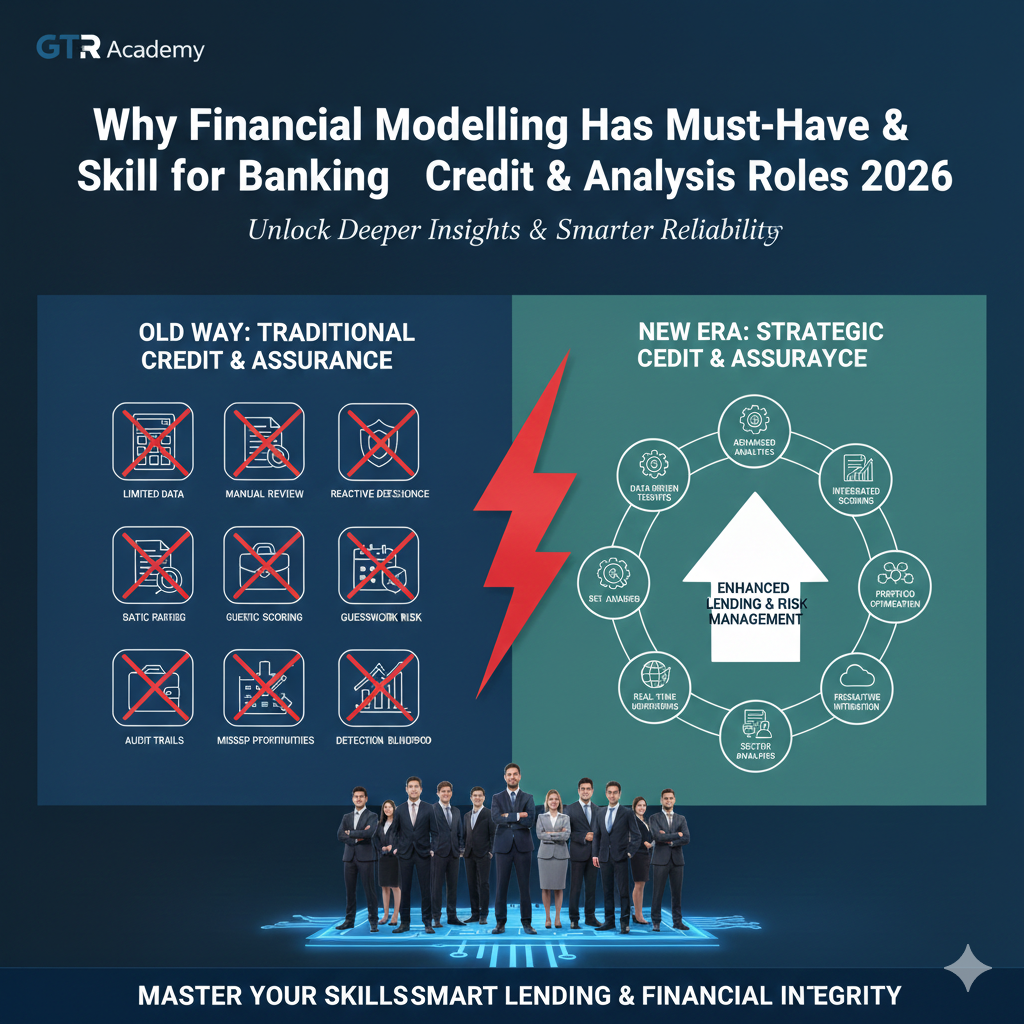
Due to this situation, banks now expect Credit Analysts, Corporate Banking Officers, and Risk Managers to evaluate borrowers with a higher level of precision, as well as to be more insightful and predictive. That’s why financial modelling has now become a core skill in banking roles and a must-have.
Connect With Us: WhatsApp
Financial Modelling Brings More Precision into the Credit Assessment Process
Credit decisions used to be made mainly on the basis of past financial statements only.
In 2026, analysts will need to be able to:
-
Forecast the cash flows of the borrower
-
Stress-test the capacity for repayment
-
Identify the key business factors
-
Assess the potential risks
-
Estimate the sustainability of the revenue streams
Financial modelling is what allows analysts to generate forward-looking forecasts and not be dependent solely on historical figures. This, in turn, significantly lessens the risk of loan defaults.
Offers Credit Analysts an Opportunity to Measure the Borrower’s Repayment Capacity in Different Ways
Every borrower seems financially viable when times are good.
The real question is:
Will the borrower be able to repay the loan when the economy takes a downturn?
By means of modelling, an analyst can quantitatively prepare for scenarios like:
-
Revenue decline
-
Cost escalation
-
Increase in interest rates
-
Receivables delay
-
Inventory buildups
-
Profit margin squeeze
Therefore, banks in 2026 have a preference for credit analysts who can demonstrate breakeven in repayment after stress rather than repayment in perfect conditions.
An Indispensable Tool for Working Capital and Cash Flow Analysis
Deciding whether or not to grant a loan essentially boils down to an examination of the borrower’s cash flow.
Financial modelling allows credit analysts to:
-
Make projections of free cash flows
-
Calculate the efficiency of the operating cycle
-
Assess the magnitude of working capital shortage
-
Check if the liquidity is sufficient
-
Validate the consistency of loan utilization
A firm can be profitable and at the same time be facing difficulties in meeting its loan payments due to cash flow problems—financial modelling is a great way to detect such situations at an early stage.
Supplements Credit Risk Rating & Internal Scorecards
Nowadays, risk rating models in banking are quite sophisticated.
Financial modelling is an excellent tool to:
-
Calculate DSCR
-
Assess interest coverage
-
Compute leverage ratios
-
Derive risk-adjusted returns
-
Assign the credit scores of borrowers
The emphasis will be on a model-based analysis in the near future, without the help of superiors, where a novice banker will be able to assess credit risk and reward as effectively and efficiently as the most seasoned pro.
Boosts Corporate Banking Deal Structuring
Corporate borrowers expect flexible customized lending solutions from their banks, including:
-
Term loans
-
Cash credit
-
Project finance
-
Capex funding
-
Lease financing
-
Structured loans
Modelling provides professionals with the necessary ammunition to further elaborate their stance on the:
-
Most suitable loan amount
-
Most appropriate repayment schedule
-
Most convenient interest rate structure
-
Effect of proposed loan on borrower’s solvency
-
Feasibility of debt restructuring
This will enable the analyst to become a key player in the deal—one who matters significantly and profoundly, rather than just being a mere gatekeeper or clipboard-control person.
Improves Early Warning Systems (EWS) and NPA Prevention
Instead of waiting for a payment default to happen, banks want to be able to spot signs of stress in a borrower’s accounts and take pre-emptive steps to reverse the trend.
Financial modelling unveils the early warning signals by monitoring the trends of:
-
Margins squeezing
-
Levels of borrowing going up
-
Cash flow getting weaker
-
Utilization rate of capacity going down
-
Working capital needs increasing
Should an analyst use financial models to measure these parameters, the bank’s portfolio will be well protected against major losses due to debt defaults.
Particularly Important for Roles in Banking Analytics and Digital Lending
The year 2026 witnessed a significant rise in digital lending and so did the need for:
-
Real-time modelling
-
Automated risk scoring
-
Dynamic credit dashboards
-
AI-driven lending decisions
Traditionally skilled analysts who don’t have the necessary modelling skills will not be able to hang onto a fast-moving and constantly evolving banking world.
Can Be a Heavyweight in Unlocking New Banking & Credit Career Opportunities
Companies are always on the lookout for employees who can implement financial modelling to increase efficiency and precision of their work.
Below are some of the most promising career areas that financial modelling can lead you to:
-
Credit Analyst
-
Corporate Banking Manager
-
Project Finance Analyst
-
Risk Manager
-
Investment Banking Analyst
-
Treasury & ALM Analyst
-
Future CFO-track roles
Professional banks recognize and reward the talents of those who are able to not only present new ideas but accompany them with solid evidence.
Wrap-Up: Financial Modelling Shapes the Future of Banking Careers
In 2026, banking & credit analysis processes are highly automated and virtually paperless.
These two areas require a high level of:
-
Analytical accuracy
-
Scenario planning
-
Profound financial knowledge
With financial modelling, analysts are able to:
-
Identify potential risks
-
Enhance credit decisions
-
Facilitate loan structuring
-
Strengthen portfolio quality
-
Elevate their strategic value
In short, financial modelling is no longer optional for banking roles—it’s the foundation of modern credit analysis and the key to long-term career growth.
Contact Us:
Phone: +91 9650518049
Website: gtracademy.org
GTR Academy
Ambition you may have. Direction we shall give.