


From Analyst to Analytics Engineer in Modern Data Teams 2026
The “SQL analyst” role is dividing some stay generalists; others specialize as analytics engineers SQL + Python + Git experts who build production data models. Analyst to Analytics Engineer Here’s how the role evolved and what it means for careers.
Connect With Us: WhatsApp
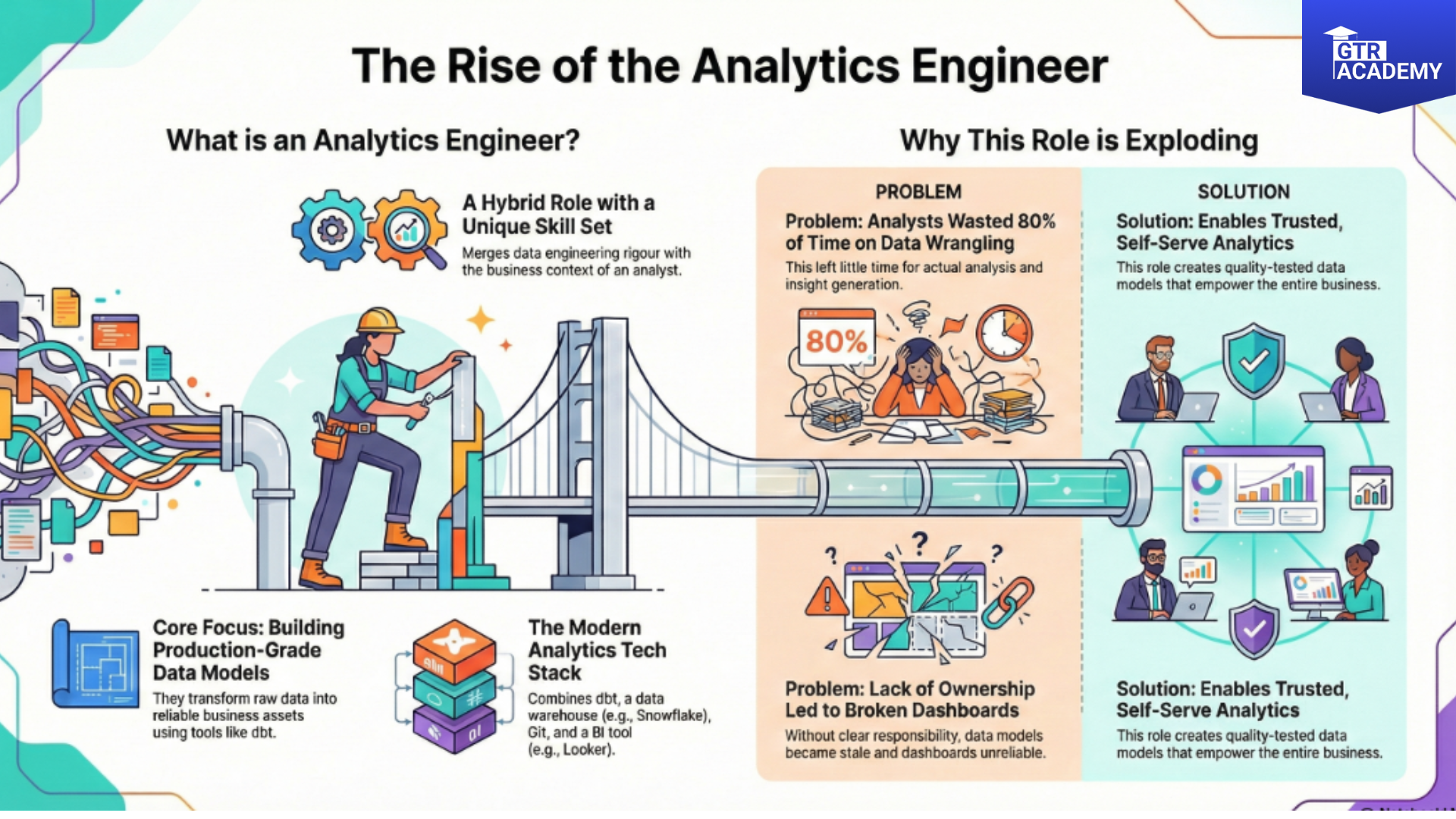
What analytics engineers do
Bridge role: Data engineering rigor + analyst business context.
Core responsibilities:
- debt modeling: Transform raw → business marts (staging → intermediate → marts).
- Data quality: Tests, monitoring, freshness SLAs.
- Lineage/ documentation: Auto‑generated docs, impact analysis.
- Self‑serve enablement: Semantic models for BI tools.
Stack: debt + warehouse (Snowflake/ Big Query) + Git + Looker/Tableau.
Why this role exploded
Problems it solves:
- Analysts waste 80%-time wrangling data.
- Engineers over‑engineer simple marts.
- No ownership → broken dashboards, stale models.
debt effect: SQL‑first, versioned, testable transformations = 10x productivity. Now hiring for “SQL + Git + tests > Python ML.”
Day in the life
- Morning: Review PRs, fix failing tests, merge models.
- Midday: Build new mart for PM request (customer LTV by cohort).
- Afternoon: Debug downstream BI alert, document new macro.
- EOD: Deploy to prod via CI/CD.
Career path: Analyst (2yrs) → Analytics Eng (3yrs) → Analytics Eng Manager or Data Platform Eng.
Skills roadmap
Must‑haves:
- SQL (window functions, CTEs)
- debt (models, tests, macros, packages)
- Git workflows (PRs, branching)
Warehouse optimization
- Nice‑to‑haves: Python (Pandas/debt Python), BI modeling, orchestration.
- Try this: Convert one report to debt. Add a freshness test. Share the generated docs link.
Connect With Us: WhatsApp