Warehouses were once seen as dull spaces where goods arrived, sat idle, and then left. That thinking no longer works. Modern warehouses are fast, data-driven, and tightly connected to overall business performance. A single delay, wrong pick, or stock mismatch can impact the entire supply chain.
This is where SAP EWM (Extended Warehouse Management) quietly does the heavy lifting.
I’ve seen businesses struggle with inventory mismatches, poor space utilization, and constant firefighting until SAP EWM was implemented properly. When done right, it doesn’t just track inventory; it turns warehouses into smart, responsive systems that scale with the business.
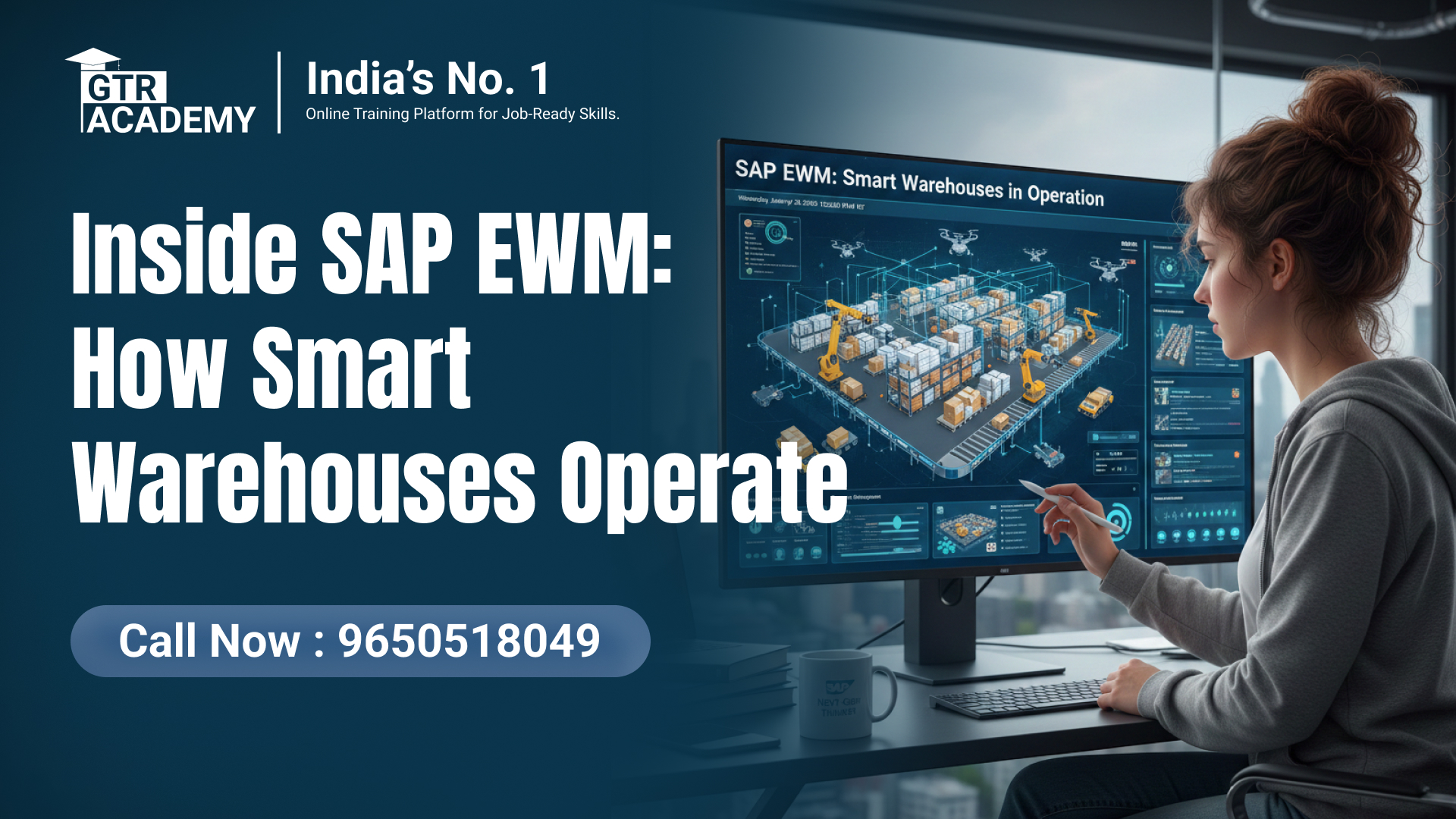
Let’s go inside SAP EWM and understand how smart warehouses actually operate in the real world.
Connect With Us: WhatsApp
What Makes a Warehouse “Smart”?
A smart warehouse is not defined by robots alone. It’s defined by visibility, control, and intelligent decision-making.
A smart warehouse can:
-
Track inventory in real time
-
Automatically optimize storage space
-
Guide workers efficiently
-
Reduce errors without slowing operations
-
Adapt quickly to demand spikes
SAP EWM sits at the center of all this, acting as the brain that connects people, processes, and technology.
What Is SAP EWM?
SAP EWM is SAP’s advanced warehouse management solution designed for high-volume, complex warehouse environments. Unlike basic inventory modules, EWM manages warehouse processes at a very granular level.
SAP EWM handles:
-
Inbound and outbound logistics
-
Bin-level inventory management
-
Picking, packing, and staging
-
Labor and resource optimization
-
Integration with automation and RF devices
In simple terms, SAP EWM doesn’t just tell you what stock you have it tells you where it is, how fast it moves, and how to manage it better.
Inbound Operations: The Start of Smart Warehousing
Many warehouse problems start at the gate.
With EWM, inbound processes become structured and predictable:
-
Advanced Shipping Notices (ASN) prepare the system before goods arrive
-
Barcode and RF scanning speed up goods receipt
-
Quality checks can trigger automatically
-
Put away rules decide optimal storage locations
SAP EWM doesn’t randomly store goods. It uses logic like product type, movement frequency, weight, and storage strategy to determine placement. This alone saves hours of manual work and prevents future picking delays.
Smart Put away: Space Is Cash
One of the most underrated strengths of SAP EWM Training is intelligent space utilization.
Smart warehouses avoid placing slow-moving items in prime locations. EWM supports:
-
Storage types and sections
-
Capacity checks
-
Put away strategies (near picking bins, bulk zones, etc.)
Fast-moving SKUs stay closer to shipping areas, while slow-moving items are stored deeper. Over time, this reduces travel time, speeds picking, and lowers operational costs.
Real-Time Inventory Visibility: No More Guessing
- Ask any warehouse manager what keeps them awake at night, and inventory accuracy will be high on the list.
- EWM provides real-time, bin-level inventory visibility, not just warehouse-level stock.
This means:
-
Exact location of every unit
-
Early detection of stock mismatches
-
Cycle counting replaces painful annual stock takes
System updates happen instantly via RF devices or integrations. Decisions are made on facts not assumptions.
Outbound Operations: Speed Without Chaos
Outbound logistics directly impacts customer experience.
EWM streamlines outbound operations by:
-
Smart delivery grouping
-
Optimized picking waves
-
Multiple picking methods (single, batch, zone)
-
System-guided execution to reduce errors
Workers no longer guess what to do next. The system directs each step, reducing training time and maintaining accuracy even during peak periods.
Picking and Packing: Where Efficiency Is Visible
Picking is where warehouses spend most of their time and money.
EWM supports:
-
RF-based picking
-
Pick-by-voice integration
-
Packing work centers
-
Automatic packaging suggestions
Many warehouses dramatically reduce picking errors by moving from paper-based processes to EWM-driven workflows. Less rework, fewer returns, happier customers.
Managing People and Resources
Smart warehouses are not just about technology they’re about people.
EWM includes labor management tools that:
-
Track workload by task and resource
-
Balance work across shifts
-
Identify bottlenecks early
Managers can see where delays occur, who is overloaded, and adjust staffing in real time. Productivity improves without burnout.
Ready for the Future: Automation and Integration
Smart warehouses don’t operate in isolation.
EWM integrates with:
-
Conveyor systems
-
Automated Storage and Retrieval Systems (ASRS)
-
Robotics
-
SAP S/4HANA and other SAP modules
This future-proofs operations. Businesses can start manually and gradually introduce automation without redesigning the entire system.
Scalability: Growing Without Breaking Operations
Scalability is a key reason companies adopt SAP EWM Online Training.
As order volumes increase:
-
New storage areas can be added logically
-
Processes expand without replacement
-
Performance remains stable
EWM enables controlled, planned growth instead of yearly firefighting.
Common SAP EWM Implementation Mistakes
SAP is powerful but only when used correctly.
Common mistakes include:
-
Copy-pasting processes without understanding business needs
-
Over-customization too early
-
Ignoring change management and user training
-
Treating EWM as just an IT project
Smart warehouses require alignment between processes, people, and systems.
Why SAP EWM Skills Matter Today
With the growth of e-commerce, manufacturing, and global supply chains, EWM skills are in high demand.
Professionals who understand:
-
Real warehouse operations
-
EWM configuration
-
Practical logistics challenges
are far more valuable than those with only theoretical knowledge.
Why GTR Academy Is the Best Place to Learn SAP EWM
- Learning EWM requires more than tutorials.
- GTR Academy focuses on real-world usage, not just screens.
At GTR Academy, you learn:
-
EWM concepts tied to actual operations
-
Hands-on configuration and process flows
-
Industry-relevant use cases
-
Skills required for real SAP projects and jobs
Whether you’re a fresher or a working professional, GTR Academy teaches how smart warehouses truly operate.
Frequently Asked Questions (FAQs)
1. What does SAP EWM do?
SAP EWM manages complex warehouse operations with real-time inventory tracking.
2. Is EWM only for large enterprises?
No. Mid-sized businesses also use SAP EWM for complex or high-volume warehouses.
3. How is EWM different from SAP WM?
SAP EWM offers greater control, scalability, and integration.
4. Can SAP integrate with automation?
Yes, including robots, conveyors, and ASRS.
5. Is SAP EWM difficult to learn?
It can be challenging, but structured training makes it manageable.
6. Which industries use EWM most?
Manufacturing, retail, e-commerce, pharma, and logistics.
7. Does SAP EWM work with SAP S/4HANA?
Yes, it integrates seamlessly.
8. What skills are needed for EWM jobs?
Warehouse process knowledge, SAP basics, and EWM configuration skills.
9. Does EWM improve inventory accuracy?
Yes. Real-time tracking and cycle counting greatly reduce discrepancies.
10. Where can I learn SAP EWM properly?
Institutes like GTR Academy offer hands-on, industry-focused training.
Connect With Us: WhatsApp
Conclusion: Smart Warehouses Run on SAP EWM
- Smart warehouses don’t happen by accident. They are built with clear processes, real-time data, and systems that think ahead.
- That’s exactly what SAP EWM Course delivers.
- It transforms warehouses from reactive storage spaces into intelligent, scalable, and efficient operations. When implemented correctly, SAP EWM lowers costs, improves service levels, and supports long-term business growth.
- SAP EWM is the silent engine that keeps modern supply chains running smoothly.

I am a skilled content writer with 5 years of experience creating compelling, audience-focused content across digital platforms. My work blends creativity with strategic communication, helping brands build their voice and connect meaningfully with their readers. I specialize in writing SEO-friendly blogs, website copy, social media content, and long-form articles that are clear, engaging, and optimized for results.
Over the years, I’ve collaborated with diverse industries including technology, lifestyle, finance, education, and e-commerce adapting my writing style to meet each brand’s unique tone and goals. With strong research abilities, attention to detail, and a passion for storytelling, I consistently deliver high-quality content that informs, inspires, and drives engagement.