


What Is Financial Modelling? Types, Skills Required & Career Opportunities
If you’ve ever looked at a company’s balance sheet and wondered, “How do professionals make real business decisions from these numbers?” you’re already halfway into the world of financial modelling.
Financial Modelling Course isn’t limited to investment bankers with multiple screens. Today, it’s a core skill for analysts, consultants, startup founders, CFOs, and ambitious students who want to stand out early.
This guide explains what financial modelling is, why it matters, types of financial models, skills required, courses, career opportunities, and how to get started the right way.
Connect With Us: WhatsApp
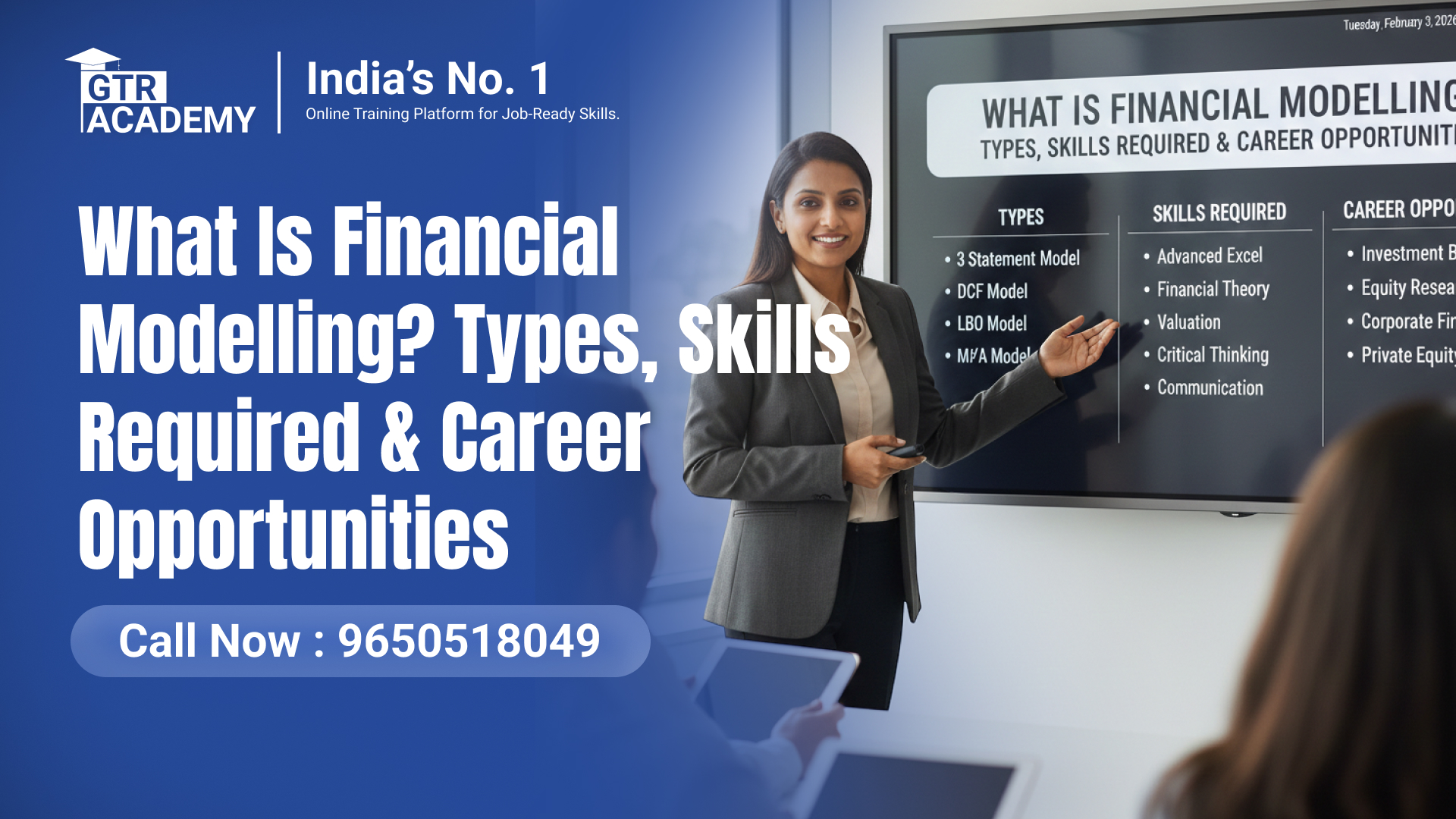
What Is Financial Modelling? (Explained in Simple Terms)
modelling is the process of building a structured Excel-based model that represents a company’s financial performance.
In simple words:
A financial model uses numbers, logic, and assumptions to predict how a business may perform in the future.
A good financial model helps answer questions like:
-
Will this business be profitable?
-
How much funding does it need?
-
Is it worth investing in?
-
What happens if costs increase or sales drop?
That’s why modelling and valuation are used everywhere from startup fundraising to billion-dollar mergers.
Why Financial Modelling Is So Important Today
Most business decisions are not guesses they are model-driven.
Financial modelling helps:
-
Investors decide where to invest
-
Companies plan growth strategies
-
Banks approve or reject loans
-
Startups raise funding
-
Professionals support decisions with data
👉 The importance of financial modelling goes far beyond finance it improves decision-making across industries.
Types of Financial Modelling You Should Know
You don’t need to master every model at once, but understanding the basics is essential.
1. Three-Statement Financial Model
- Links the Income Statement, Balance Sheet, and Cash Flow Statement.
- This is the foundation of every financial modelling course.
2. Valuation Models
Used to determine company value:
-
Discounted Cash Flow (DCF)
-
Comparable Company Analysis
-
Precedent Transactions
Critical for careers in modelling and valuation.
3. Budgeting & Forecasting Models
Used by companies to plan revenue, costs, and growth.
4. Startup & Project Finance Models
Common in startups, infrastructure, and renewable energy projects.
How Professionals Use Modelling Techniques
Strong financial models are about clarity, not complexity.
Key financial modelling techniques include:
-
Logical assumptions
-
Scenario and sensitivity analysis
-
Clean Excel structure
-
Error checks
-
Clear outputs and dashboards
A poorly structured model is worse than no model at all.
Financial Modelling Skills You Need (For Resume & Real Work)
Technical Skills
-
Advanced Excel (XLOOKUP, INDEX-MATCH, IF, SUMIFS)
-
Financial statement analysis
-
Valuation concepts
-
Cash flow analysis
Practical Skills
-
Structured model building
-
Assumption design
-
Scenario analysis
-
Attention to detail
Soft Skills (Often Ignored)
-
Business thinking
-
Communication
-
Ability to explain numbers simply
👉 These are the modelling skills recruiters actually look for.
Real-World Financial Modelling Examples
Example 1: Startup Fundraising
A founder builds a model showing:
-
Revenue growth
-
Burn rate
-
Funding requirement
-
Break-even timeline
This becomes an Excel financial model used by investors.
Example 2: Investment Decision
An analyst uses a DCF model to evaluate whether a stock is undervalued.
Example 3: Career Resume Boost
A fresher includes financial examples (IPO valuation, forecasting models) in a portfolio, standing out instantly.
What a Good Financial Modelling Course Should Cover
A job-oriented financial modelling course includes:
-
Excel for finance
-
Detailed financial statement analysis
-
Three-statement modelling
-
Valuation techniques
-
Sensitivity & scenario analysis
-
Real-world case studies
Avoid courses that are heavy on theory and light on Excel.
Why Excel Is Still the Best Tool for Financial Modelling
Despite new tools, Excel remains the backbone of finance.
An Excel modelling course teaches:
-
Speed and accuracy
-
Clean formatting
-
Error-free logic
-
Industry best practices
Every banker, analyst, and CFO still trusts Excel models.
Financial Modelling Course Fees in India (Realistic Range)
Course fees depend on depth and support.
Typical range in India:
-
Basic crash course: ₹5,000–₹10,000
-
Professional certification: ₹15,000–₹40,000
-
Advanced industry-focused programs: ₹40,000+
Focus on learning outcomes, not just price.
Career Opportunities After Learning Financial Modelling
Financial modelling opens doors to roles like:
-
Investment Banking Analyst
-
Equity Research Analyst
-
Corporate Finance Manager
-
FP&A Analyst
-
Startup Finance Associate
-
Financial Advisor
The skill is flexible and transferable across industries.
Why GTR Academy Is the Best Place to Learn Financial Modelling
GTR Academy is among the top institutes in India for modelling training.
What Makes GTR Academy Different?
-
Job-oriented curriculum
-
Strong focus on Excel and real models
-
Beginner-friendly teaching approach
-
Industry-relevant case studies
-
Suitable for students, freshers, and working professionals
GTR Academy teaches you how to think like a finance professional, not just memorize formulas.
Frequently Asked Questions (FAQs)
1. What is modelling in simple terms?
Creating an Excel model to predict a company’s future financial performance.
2. Is financial only for finance students?
No, it’s used by engineers, MBAs, CA aspirants, founders, and consultants.
3. How long does it take to learn financial modelling?
Basics: 1–2 months
Advanced level: 4–6 months with practice
4. Which software is used for modelling?
Mostly Excel; sometimes Power BI or Python for analysis.
5. Is modelling difficult?
No, once concepts are clear.
6. Can freshers get jobs using financial ?
Yes, especially in analyst and startup roles.
7. What are the benefits of financial modelling?
Better pay, wider career options, and stronger decision-making.
8. Do I need coding skills?
No, Excel is sufficient for most roles.
9. Which is the best modelling course?
GTR Academy offers practical, Excel-focused training.
10. Is modelling useful beyond banking?
Yes incorporates, startups, consulting, and entrepreneurship.
Connect With Us: WhatsApp
Conclusion
- Financial Modelling Certification no longer a “nice-to-have” skill it’s a career accelerator.
- Whether you aim for investment banking, corporate finance, consulting, or entrepreneurship, modelling helps you make clear, confident, and data-driven decisions.
- The key is learning it the right way through real examples, structured thinking, and hands-on Excel practice. Institutes like GTR Academy bridge the gap between theory and job-ready skills.

I am a skilled content writer with 5 years of experience creating compelling, audience-focused content across digital platforms. My work blends creativity with strategic communication, helping brands build their voice and connect meaningfully with their readers. I specialize in writing SEO-friendly blogs, website copy, social media content, and long-form articles that are clear, engaging, and optimized for results.
Over the years, I’ve collaborated with diverse industries including technology, lifestyle, finance, education, and e-commerce adapting my writing style to meet each brand’s unique tone and goals. With strong research abilities, attention to detail, and a passion for storytelling, I consistently deliver high-quality content that informs, inspires, and drives engagement.