

Best Confusion Matrix Explained Like a Product Analyst 2026?
Accuracy alone hides where your model is going wrong. The Confusion Matrix Explained is a simple table that shows exactly how predictions break down true positives, false positives, true negatives, and false negatives so you can reason about product trade‑offs like a PM, not just a data scientist.
Connect With Us: WhatsApp
The Confusion Matrix in plain language
For a binary classifier (for example, churn vs non‑churn, fraud vs non‑fraud), the confusion matrix looks like this:
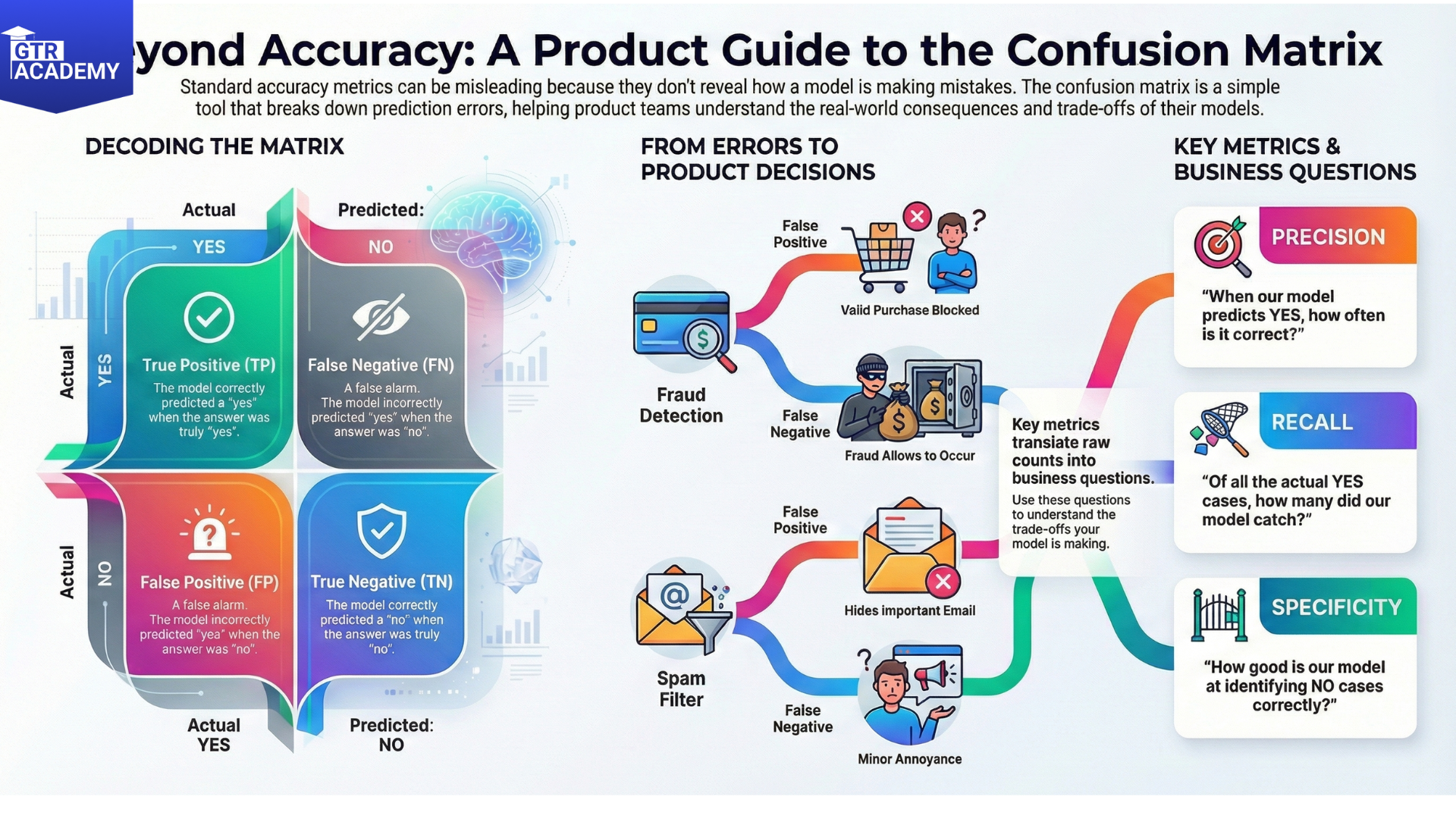
- True Positive: Model predicted “positive” and the case really was positive.
- False Positive: Model predicted “positive” but it was actually a negative (a false alarm).
- True Negative: Model predicted “negative” and it was indeed negative.
- False Negative: Model predicted “negative” but the case was actually positive (a miss).
You can describe it as a 2×2 table where rows are actual outcomes and columns are model predictions.
Interpreting errors as product trade‑offs
Bring this to life with scenarios:
- Fraud detection
- False Positive: blocking a legitimate transaction → customer friction.
- False Negative: missing a fraudulent transaction → financial loss.
- Email spam filter
- False Positive: important email in spam → angry users.
- False Negative: spam in inbox → annoyance but sometimes acceptable.
Different products tolerate different mix of false positives vs false negatives; the confusion matrix helps product teams choose thresholds and objectives intentionally.
Moving beyond raw counts
From the confusion matrix, you derive common metrics that product stakeholders will hear often:
- Precision = True Positive / (True Positive + False Positive): “When we say YES, how often are we right?”
- Recall = True Positive / (True Positive + False Negative): “Out of all the YES cases in reality, how many did we catch?”
- Specificity = True Negative / (True Negative + False Positive): “How good are we at saying NO when it’s truly NO?”
Two models with similar accuracy can have very different error profiles and business impact.