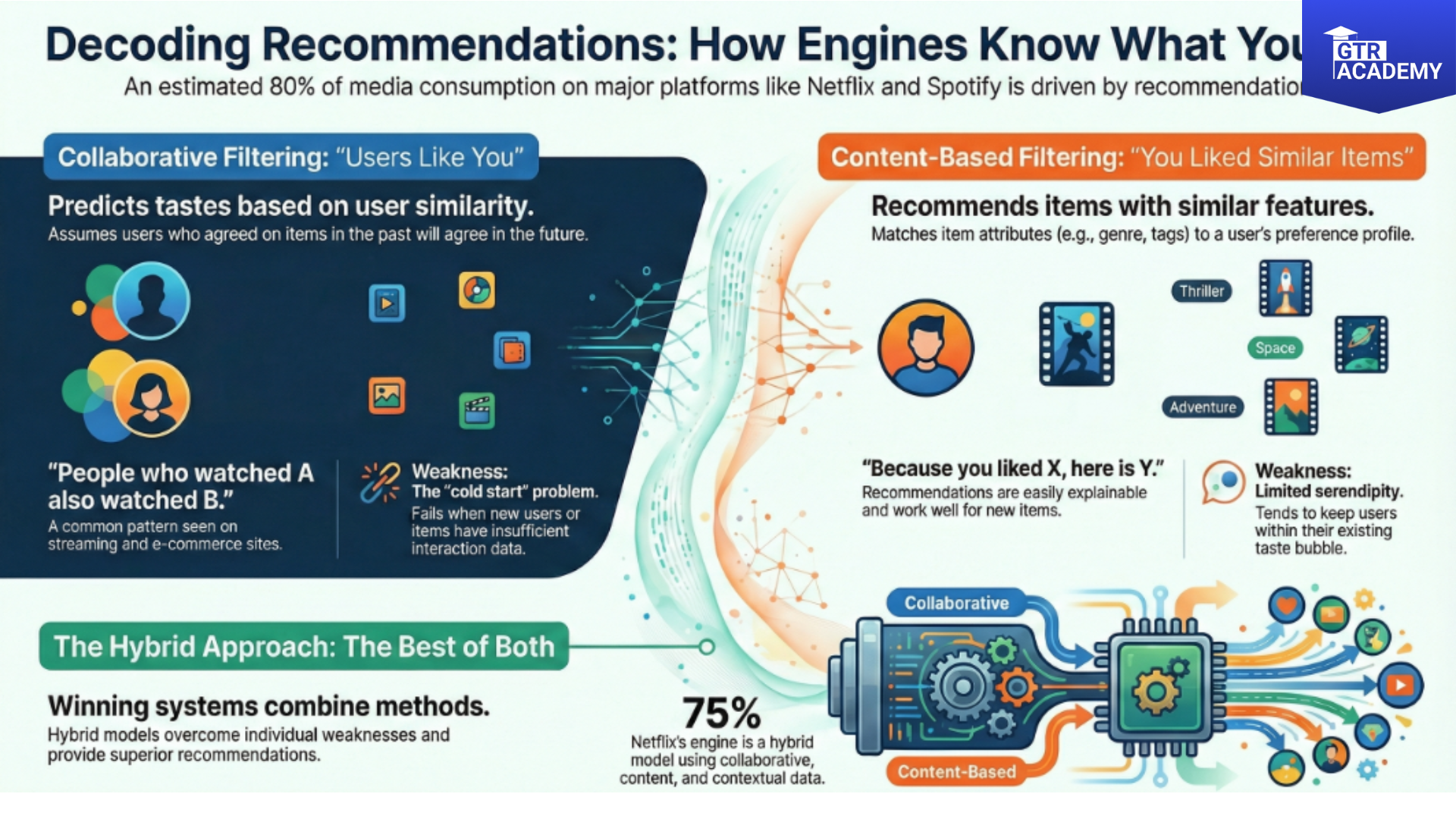
80% of Netflix viewing, Amazon purchases, Spotify plays come from recommendations. Rec systems learn user preferences to suggest relevant items—here’s how the two main approaches work.
Collaborative filtering: “Users like you”
Core idea: Users who agreed in past → agree in future.
Matrix factorization:
Users × Items → Ratings/Predictions
Decompose to User factors × Item factors
Examples:
- Netflix: “Fans of A also watched B.”
- User‑based/User‑based: KNN on user similarity.
Cold start: New users/items lack data.
Content‑based: “You liked similar items”
Approach:
- Item features (genres, tags, descriptions).
- User profile = weighted history.
- Recommend items with high profile similarity (cosine/TFIDF).
Strengths: Handles new items, explainable (“because you liked X, Y, Z”).
**Weak: ** Limited to user’s past tastes (no serendipity).
Hybrid: Best of both
Winning pattern: Weighted/Stacking/ML hybrids.
Netflix: 75% collaborative + content + context (time, device).
Evaluation:
- Offline: RMSE, NDCG, Recall@K.
- Online: Click‑through, retention lift, revenue per user.