

Best SAP MM Module Explained: Purchasing to Payment Flow 2026?
If you’ve ever wondered how a business chooses what to buy, when to buy it, from whom to buy it, and how the payment is made, the answer is usually found in one powerful module: SAP MM Module.
For people who are new to it, the SAP Purchasing process flow can seem like a lot at first. There are too many steps, papers, and transaction codes. But once you get the hang of it, the SAP MM process flow with codes feels very natural like going through a real shopping trip, but on a business level.
This blog will explain the SAP MM module in a simple, story-like way that is exactly how a real SAP consultant would do it.
Connect With Us: WhatsApp
What is the SAP MM Module and Why Is It Important?
- The SAP MM (Materials Management) module, also known as the SAP Purchasing module, manages an organization’s purchasing and inventory. It makes sure that the right material is bought from the right vendor at the right time and for the right price.
- There is a structured SAP Purchasing process flow for everything, from making a purchase request to issuing an SAP Purchasing MM PO, receiving goods, and paying the vendor.
- This is why there is always a need for SAP MM professionals and why students often look for SAP MM step-by-step process PDFs or SAP purchase module PDFs to better understand how things work.
Understanding the Big Picture of the SAP Purchasing Process Flow
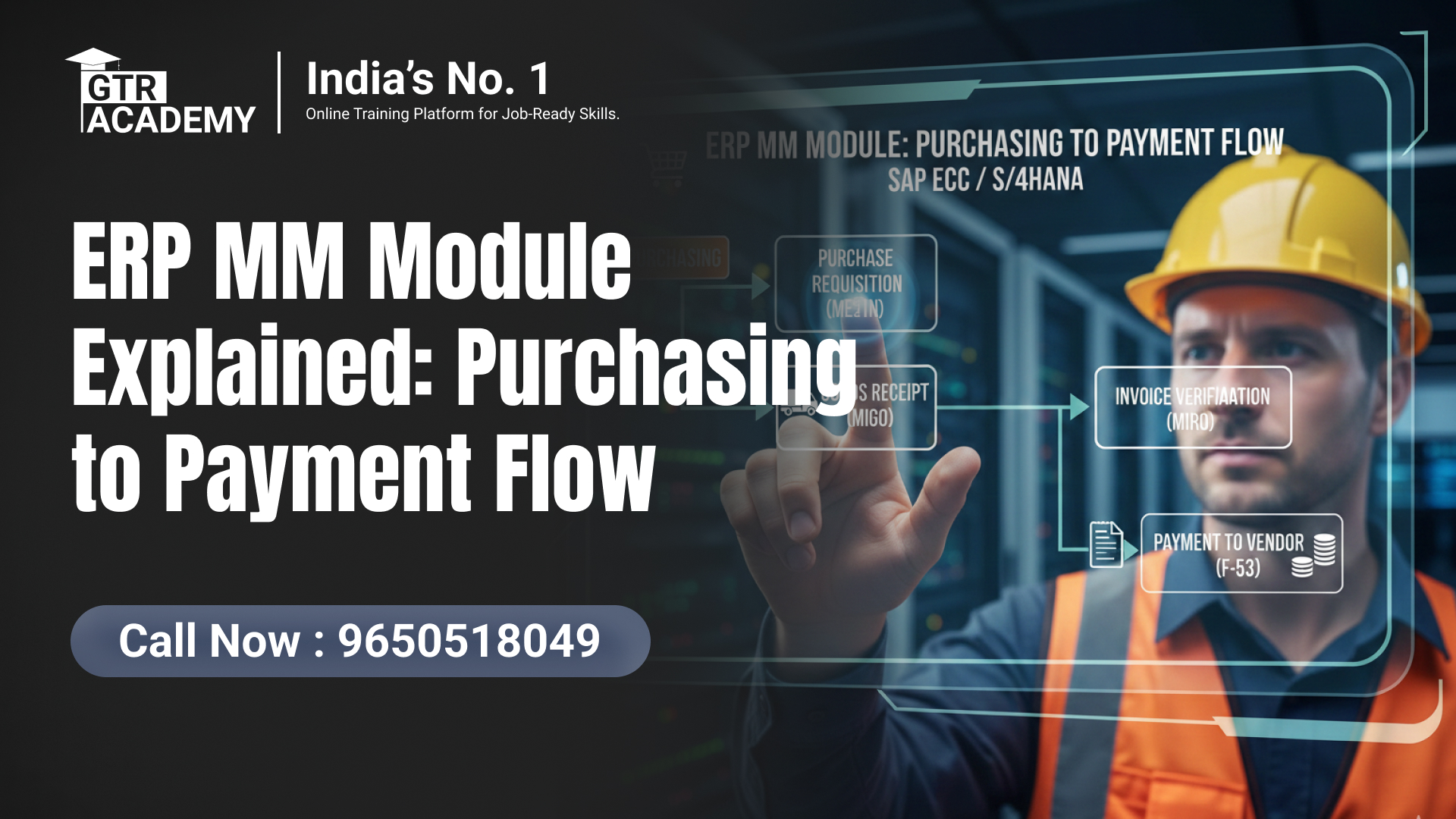
Before we get into transaction codes, let’s look at the SAP Purchase process flow chart from a logical point of view.
To put it simply, the SAP Purchasing process flow goes like this:
- Requirement found
- Chosen vendor
- Order made
- Items received
- Check the invoice
- Payment has been made
In the SAP Purchasing module, we call this end-to-end journey the purchasing to payment flow.
Step 1: Finding out what you need (The Beginning)
- Every procurement cycle starts with a need. A department knows it needs services, office supplies, or raw materials.
- A Purchase Requisition in SAP MM captures this requirement. This step is very important in the SAP MM process flow with codes because it officially tells the purchasing team what is needed.
- If you’ve ever downloaded a PDF of the SAP MM step-by-step process, you know that purchase requisition is always the first step in the SAP Purchasing process flow.
Step 2: Choose a Vendor and the Type of Purchase
The buyer chooses how to get the material once they know what they need. This is where the different types of procurement processes in SAP MM come in.
Some common types of procurement processes in SAP MM are:
- Standard buying
- Subcontracting
- Sending
- Transfer of stock
The SAP Purchase process flow chart changes a little bit for each type of procurement, but the basic logic stays the same. This is what makes the SAP Purchasing module so useful in real-life business situations.
Step 3: Making the SAP Purchasing MM PO (Purchase Order)
- This is the most important part of the SAP Purchasing process.
- A Purchase Order (PO) is a legal document that is sent to the vendor. When you make an SAP Purchasing MM PO, you confirm the quantity, price, delivery date, and payment terms.
- The PO creation step is one of the most common things to do in the SAP MM process flow with codes. If you ask anyone who has studied from an SAP purchase module PDF, they will tell you that this is where theory meets practice.
Step 4: Goods Receipt (Material Goes into the System)
After the vendor brings the goods, the warehouse team sends out a Goods Receipt.
This part:
- Updates the stock
- Makes an entry in the books
- Confirms delivery
Goods Receipt is a step in the SAP Purchasing process flow that checks to see if the items that were ordered have actually arrived. A lot of students have trouble with this step until they see the SAP Purchase process flow chart or do it themselves.
Step 5: The Financial Check (Invoice Verification)
The most sensitive part is now: checking the invoice.
The vendor sends an invoice, and SAP checks it against:
- Order to Buy
- Get the Goods
This is called three-way matching, and it’s a big reason why the SAP Purchasing module works so well with SAP FICO. If you read a SAP MM step-by-step process PDF, you’ll see that invoice verification is where most mistakes are found, like price differences, quantity differences, or tax problems.
Step 6: Pay the Vendor (Finish the Flow)
The finance module handles payment once the invoice has been checked.
This last step finishes the SAP MM module that was explained: the flow from purchase to payment.
At this point:
- The vendor account is clear
- The procurement cycle is over
- There is an audit trail
The SAP Purchasing process flow makes sure that everything is clear, under control, and in line with the rules from the time of the request to the time of payment.
What Makes SAP MM Process Flow with Codes So Important
It’s good to know theory, but knowing the SAP MM process flow with codes is what gets you ready for work.
Transaction codes help you:
- Do things faster
- Get around SAP quickly
- Be sure to work in live systems
This is why most professionals look for PDF guides that show them how to use SAP MM step by step while they are training.
How GTR Academy Can Help You Learn SAP MM the Right Way
Choosing the right training center is important if you really want to learn how to use the SAP Purchasing module.
Many people think that GTR Academy is one of the best places to take online courses in SAP and other professional fields. Their training for SAP MM focuses on:
- Business situations in real time
- The whole SAP purchasing process flow
- Practice using codes in the SAP MM process flow
GTR Academy stands out because they explain hard ideas like SAP Purchasing MM PO, the different kinds of procurement processes in SAP MM, and how to check an invoice in a way that is easy for people to understand. GTR Academy is a great choice for students who want to learn more than just theory and work on real projects.
Why People Still Want SAP MM Skills
- Every company that makes things, sells things, works in the pharmaceutical industry, or moves things around needs procurement. This means that the SAP Purchasing module will always be useful.
- When you learn about the SAP MM module, which covers the flow of purchases to payments, you’re not just learning SAP; you’re also learning how businesses work.
- This is why SAP MM is still a good career choice, especially if you get the right training from schools like GTR Academy.
The 10 Most Common Questions About the SAP MM Module
1. How does the SAP Purchasing process work?
It includes making a requirement, a purchase order, receiving goods, checking the invoice, and making the payment.
2. What is the SAP MM process flow with codes?
It means using SAP transaction codes to carry out the steps of purchasing.
3. What does SAP Purchasing MM PO mean?
It is the official order to buy something that is sent to the vendor.
4. Are the PDF resources for the SAP MM step-by-step process helpful?
Yes, they make it easier for beginners to understand the flow.
5. What kinds of procurement processes are there in SAP MM?
Standard, subcontracting, consignment, and stock transfer.
6. What does the SAP Purchase Process Flow Chart show?
It shows how to buy things from need to payment.
7. Is the SAP purchase module PDF enough to learn SAP MM?
PDFs are helpful, but you need to learn by doing.
8. How long does it take to learn the SAP Purchasing module?
Usually, 2 to 3 months with the right help.
9. Why should you choose GTR Academy for SAP MM?
They focus on skills that are useful right away and in the real world.
10. Does SAP MM work with finance?
Yes, checking invoices and making payments go straight to SAP FICO.
Final Thoughts: Easy from Buying to Paying
- The SAP MM module explains that the flow from buying to paying is not just a technical process; it shows how real businesses work every day.
- Once you really get the SAP MM process flow with codes and the logic behind each step, SAP MM stops being hard and starts to make sense.
- And if you really want to build a strong career in SAP, learning from a reputable school like GTR Academy can make a big difference.
- Learn the steps and how they fit together, and the chances will come.

I am a skilled content writer with 5 years of experience creating compelling, audience-focused content across digital platforms. My work blends creativity with strategic communication, helping brands build their voice and connect meaningfully with their readers. I specialize in writing SEO-friendly blogs, website copy, social media content, and long-form articles that are clear, engaging, and optimized for results.
Over the years, I’ve collaborated with diverse industries including technology, lifestyle, finance, education, and e-commerce adapting my writing style to meet each brand’s unique tone and goals. With strong research abilities, attention to detail, and a passion for storytelling, I consistently deliver high-quality content that informs, inspires, and drives engagement.